

Nordic hamstring curl without a partner: 5 ways to start solo


Yes, you can do Nordic hamstring curls without a partner. What you need is stable ankle fixation and a regression that matches your current level. This article gives you five practical solo options plus a clear progression path.
In short
The classic Nordic hamstring curl is often explained as if someone always has to hold your ankles. In practice, that is exactly why many athletes never do the exercise consistently: the setup feels inconvenient.
But the exercise does not require a partner. It requires fixation. If you solve that fixation safely, you can train perfectly well on your own. For most people, the real question is not whether solo training is possible, but how to start today with a setup they can actually repeat.

Why you do not need a partner
A training partner is only one way to keep your ankles in place. Biomechanically, the goal of the exercise stays the same: your hamstrings control the forward fall eccentrically. Whether that happens with a partner, a bench, a fixed anchor or a Nordbelt-style setup matters less than three other things (Medeiros et al., 2020):
- the fixation is stable;
- your hips stay long and extended;
- you build the load up instead of forcing it.
If you want to train solo, what you need most is not more theory, but a setup you will actually use every week. If you want to see that fixation in practice, the how-to guide is the most logical next step after this article.
5 ways to start solo
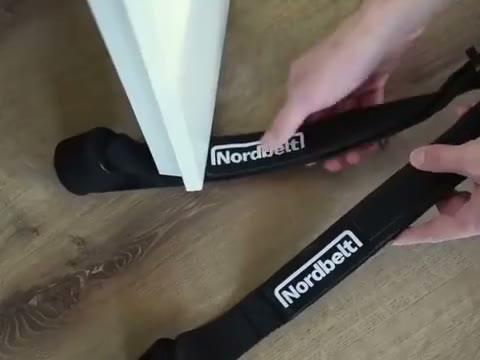
1. Door setup
A door setup is quick and compact. Only use a door that closes away from you and test it hard before starting. This is most useful for people training at home with limited space.
2. Heavy bench or fixed edge
A heavy training bench or another solid fixed edge often feels more secure than a door. This works well for people in a gym or home gym.
3. Fence or low fixed anchor
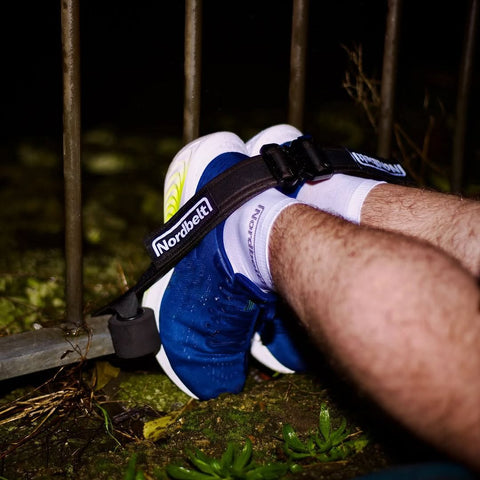
Outdoors or in a garage, a fence, low rack or other fixed anchor can be the most robust option. This is useful if you have access to a reliable anchor and do not want to improvise.
4. Band-assisted solo Nordic
If you cannot yet control the braking phase long enough, a resistance band can work as a regression. You keep the same movement pattern, but reduce the effective load. This is useful for beginners and rehabilitation build-up.
5. Dedicated solo fixation
The most practical option is a setup specifically designed for solo use, so you do not have to improvise every session. This is the best fit for athletes who want to use the exercise week after week with as little friction as possible.
For supported Nordic curls, Nordbelt provides ankle fixation.
Take your Nordic curl from the first rep to week 10.
A concrete 7-page plan: build up week by week, without pushing too fast.
- 01A clear week-by-week progression
- 02Technique and the mistakes to avoid
- 03A simple log you will actually use

≤ 51%
✓Backed by research
Van Dyk et al., 2019: meta-analysis of programmes with NHE. Not an effect test of Nordbelt or this protocol.
Open the download page again or check the email we sent you.
Open the download page ↗Which regression fits your level?
Many athletes make the mistake of treating solo training as a challenge to make the exercise as hard as possible. That is not smart. Choose your regression based on control:
- Beginner: shorter range and early hand support.
- Advanced beginner: slow eccentric lowering, then come back up with help.
- Intermediate: larger range with less hand support.
- Advanced: full negative phase and a controlled transition.
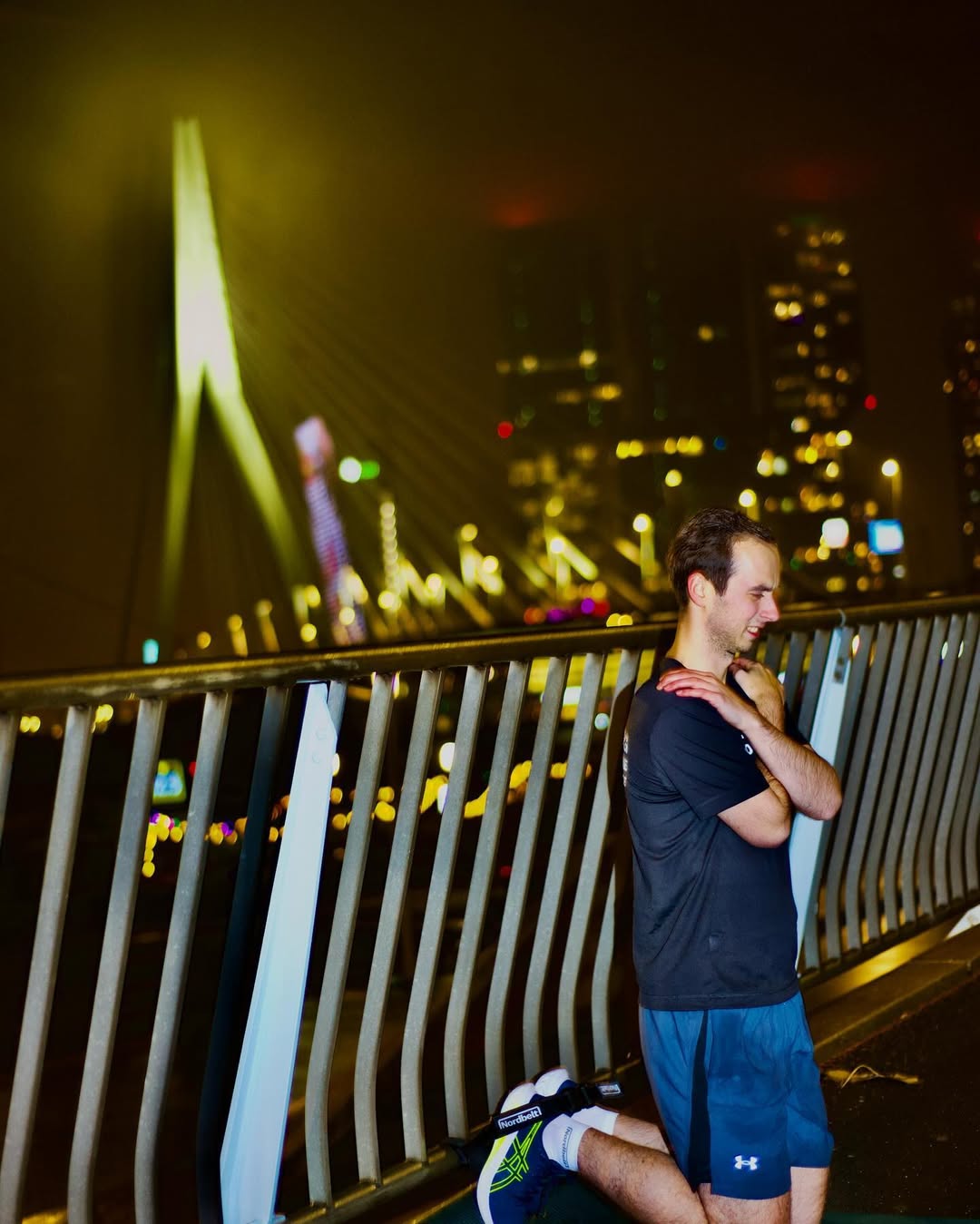
If you cannot yet lower yourself for three to five seconds under control, you are not ready for full reps. That is not a problem. It just means you first need more tension tolerance and better technique. Research on injury prevention also supports the value of consistent, progressive execution instead of jumping straight to the hardest version (Petersen et al., 2011) (Tedeschi et al., 2025).
Common mistakes when training solo
The most predictable mistakes are:
- accepting an unstable setup just to try it once;
- skipping regressions out of ego;
- doing more reps instead of better reps;
- bending at the hips and losing tension;
- confusing solo training with rushed training.
With solo Nordics, even more than usual, a safe setup is not optional. It is part of the exercise itself.
Progression path toward stronger reps
Use this simple structure:
- Choose one solo setup you trust.
- Train twice per week.
- Start with 2 to 3 sets of 4 to 5 slow eccentric reps.
- First lengthen the braking phase, not the rep count.
- Only then increase the range of motion.
- Move toward full reps only when that feels stable.
If you also want other hamstring exercises around solo Nordics, continue with hamstring exercises for home and gym.
When solo training is especially useful
Solo training is especially useful if you:
- train at home on fixed days;
- do not want your consistency to depend on another person;
- want stronger hamstrings without needing a full machine;
- want a clear bridge between general hamstring work and a heavier eccentric stimulus.
That is why solo training works best when you keep it practical: one clear setup, one manageable regression and one repeatable routine.
Frequently asked questions
Can I really do Nordic curls on my own?
Yes. You do not need a partner if your ankle fixation is safe and stable and you are not improvising with light furniture or a half-secure setup. Solo training works best when you make it repeatable: the same anchor point, the same regression and clear control over the lowering phase.
What is the safest solo setup?
That depends on your environment, but a reliable fixed setup is always safer than improvising. In practice, a dedicated fixation, a heavy bench or a well-tested door is usually safer than chairs, loose benches or setups where your ankle position keeps shifting.
Do I need a band?
Not always. A band is mainly useful as a regression if you still struggle to control the braking phase, because it lets you keep training the Nordic pattern without building too much load too soon. If you can already control several slow negative reps, a band is not necessarily needed.
When am I ready for full reps?
You are ready when you can perform multiple slow eccentric reps with a stable hip and trunk line, without collapsing or folding at the hips. In other words: first control, then more range, and only then full reps.