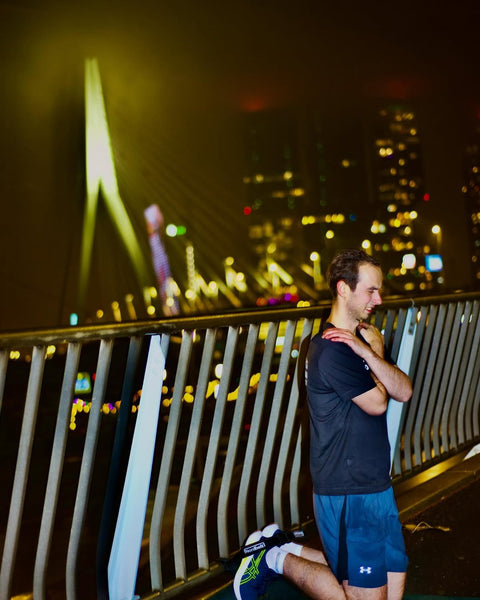


Isometric Nordic curl: technique, angle and progression


In an isometric Nordic curl, you hold a fixed position in the forward Nordic movement while your ankles remain securely fixed and your body stays as straight as possible from knees to shoulders. Choose an angle you can hold without bending at the hips, holding your breath or sinking, use hand or band assistance if needed, and first make the exercise longer or move slightly farther before reducing the assistance.
The aim is not to hang as low as possible. You should be able to enter a useful hold deliberately, maintain it calmly and leave it under control. The three-gate ladder checks your body line, breathing and exit.
What is an isometric Nordic curl?
An isometric Nordic curl is the static part of the Nordic hamstring curl. Your knees stay on the floor, your ankles remain fixed and you lean forward as one unit. Instead of lowering farther, you briefly hold one chosen position. The hamstrings then produce tension while the knee angle remains visibly unchanged.
This differs from a regular dynamic repetition. In that version, you gradually allow the knee to extend, brake the forward movement and eventually catch yourself with your hands. The general Nordic hamstring curl guide covers that full movement. This page deliberately stays with the static hold.

Three checks for a controlled isometric hold
Assess every attempt using three simple gates. The chosen angle suits your current control only while all three remain open.
- Body line: keep your knees, hips and shoulders in one line as much as possible. Your hips do not shift backward and your lower back does not take over the movement.
- Breathing: you can exhale calmly during the hold. Unintentionally holding your breath is often a sign that the position is too demanding.
- Exit: you know in advance how to leave the position safely. You can return with assistance or move calmly forward onto your hands without falling.
This ladder is not a clinical test or strength score. If one gate closes, shorten the lever or add support. That is more useful than holding the same overly demanding position for increasingly shorter periods.
How to perform an isometric Nordic curl step by step
- Place firm, soft padding beneath your knees and clear the space in front of you.
- Secure both ankles evenly and first test the setup with light tension.
- Kneel upright and make yourself long from knees to shoulders.
- Place your hands where you can use them immediately for support or to catch yourself.
- Lean forward slowly and stop before your hips bend or your breathing becomes blocked.
- Hold that position without sinking farther.
- Leave the hold by the route chosen in advance: return with hand support or move forward under control onto your hands.
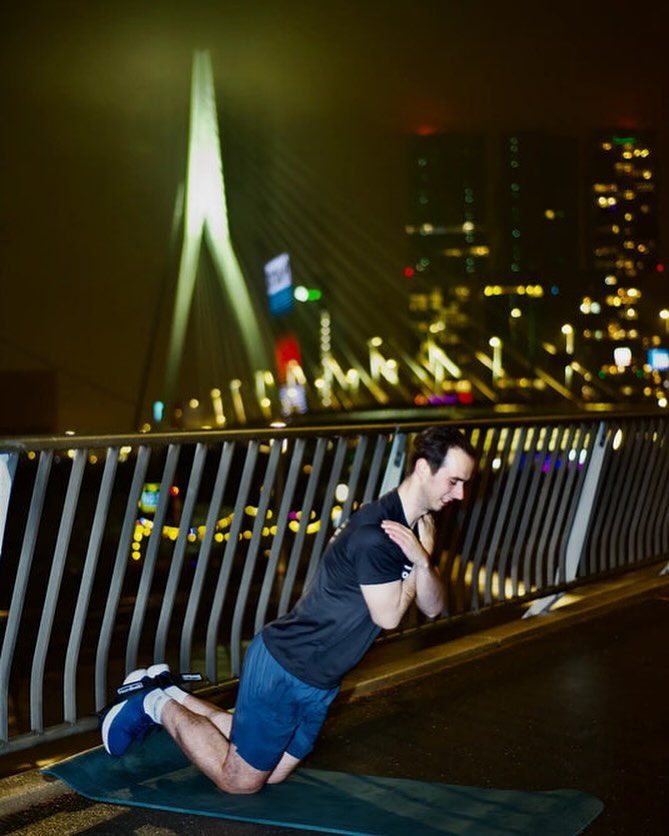
Make the first attempt easy. A smaller angle that stays constant provides more information than a deep position in which your form changes immediately.
Take your Nordic curl from the first rep to week 10.
A concrete 7-page plan: build up week by week, without pushing too fast.
- 01A clear week-by-week progression
- 02Technique and the mistakes to avoid
- 03A simple log you will actually use

≤ 51%
✓Backed by research
Van Dyk et al., 2019: meta-analysis of programmes with NHE. Not an effect test of Nordbelt or this protocol.
Open the download page again or check the email we sent you.
Open the download page ↗Which angle should you choose for a Nordic curl hold?
The right angle is the most demanding position in which all three control gates remain open. The farther your body leans forward, the longer the lever and the greater the demand on the hamstrings. There is therefore no universal angle that is best for everyone.
A laboratory study compared isometric Nordic holds at several knee and hip angles and found that measured hamstring activity changed with position (Keerasomboon et al., 2024). The researchers used a specific incline and five-second tests. This supports the importance of angle, but it does not make one investigated position a prescription for every athlete or home setup.
Do not use a number of degrees as a goal in itself. If useful, film one attempt from the side and check whether your hips stay in line. Then choose a clearly recognisable endpoint—such as a cushion, bench edge or fixed hand position—so you can reproduce the same lever in the next session.
How do you make an isometric Nordic curl easier?
Assistance belongs in the exercise when it allows you to maintain a clean position. You can place both hands on a raised surface, press your fingertips lightly into the floor or use a band that offsets part of the forward pull. Keep the support symmetrical and do not switch methods midway through the hold.
Research on assisted Nordic variations shows that changes to incline and hip position alter range of motion, torque and execution (Šarabon et al., 2019). “Assisted” is therefore not half a repetition but a different, scalable variation. Record the support you use, because a lighter band or lower hand position already makes the next hold a different task.
How do you progress the hold without losing form?
Change one variable at each step:
- hold the same angle slightly longer;
- at the same duration, choose a very slightly greater forward angle;
- at the same angle and duration, reduce the assistance a little;
- make the entry or exit smoother without making the hold harder.
If you lean farther, hold longer and use less assistance at the same time, you cannot tell which change broke your form. Keep the other two controls unchanged. Adjust something only when the last attempt had the same body line, breathing and exit as the first.
Ankle fixation for Nordic curls at home
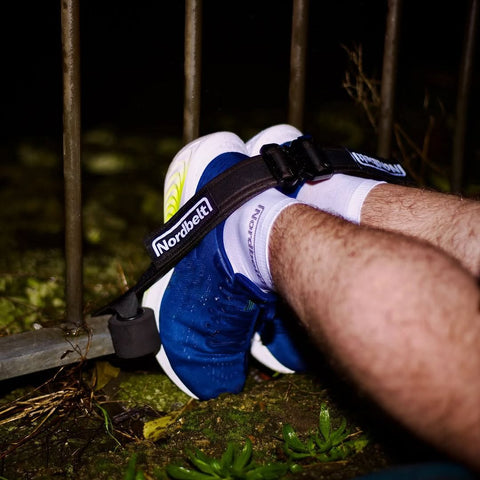
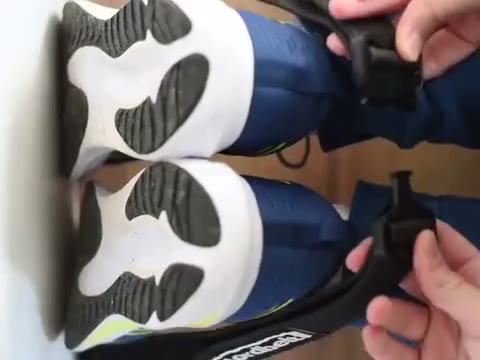
At home, you mainly need to organise a reliable counterpoint for both ankles. With Nordbelt for stable ankle fixation during Nordic curls at home, you can do that without a training partner or large gym machine, provided that the door, anchor point and clear movement area are suitable and have been checked beforehand.
The product role remains limited to the setup. Nordbelt does not choose your angle, hold duration or assistance, and it does not make an unsuitable anchor point suitable. Reduce the angle or use hand support as soon as you lose control of your line, breathing or exit.
How long should you hold a Nordic curl?
There is no fixed ideal hold duration for every athlete. Duration is one progression variable, not a competition. Start with a short period during which you clearly keep all three control gates open. End the hold as soon as your position changes noticeably; do not extend the time by shifting your hips backward or holding your breath.
What should you do with your hips, torso and ankles?
Keep your hips extended without squeezing your glutes excessively hard. Make your torso long, look diagonally towards the floor and keep your arms ready for support. You do not have to become completely rigid; you mainly want to stop the hips from moving backward first.
The ankle fixation should feel even. Research on ankle position during the Nordic found differences in factors including the break point and measured heel force, while measured hamstring activity did not differ clearly (Vicente-Mampel et al., 2022). Keep your foot position the same from one attempt to the next.
How do you leave the isometric hold?
Choose the exit before you begin. The simplest route is often to continue calmly forward and catch yourself with both hands. A second option is to return upright using hand support placed in advance or band assistance. Both are valid if you can perform them without a jolt.
Do not try to pull yourself “back after all” at the last moment once the hold is already breaking. That turns a controlled task into an unexpected maximal effort. Keep the space in front of you clear and, if useful, place an extra mat or firm cushion where your hands will land.
Can you combine isometric and dynamic Nordics?
Yes, but give each variation its own purpose. An isometric hold helps you consciously control one point of the lever. A dynamic Nordic demands control through a larger part of the movement. Training research on dynamic Nordics shows that technique and muscle activation can change after a training period (Delahunt et al., 2016). That does not make a static hold equivalent to a full repetition.
Common mistakes during Nordic curl holds
The most common mistake is choosing a position that is too deep and then shifting the hips backward. Other errors include unconsciously holding your breath, removing support abruptly, using unstable ankle fixation and failing to prepare an exit.
A hold is not better simply because it lasts longer. If the final seconds show a different posture from the first seconds, you have performed two different exercises. Use the separate page about common Nordic curl mistakes for broader technique problems and the guide to a safe Nordic home setup for the anchor, surface and clear space.
When should you stop the exercise?
Stop the attempt if the fixation shifts, your hips suddenly sink, you lose control of the planned exit, or you feel a sharp or unexpected symptom. On the next attempt, first reduce the angle or add support. Persistent, increasing or unexplained symptoms are not suitable for an online technique decision; have them assessed by a qualified healthcare professional.
Always check assembly and entry separately from the exercise. The practical how-to guide shows the setup steps. That check does not replace your own assessment of the door, anchor, material and space.
Frequently asked questions
What is the difference between an isometric and a regular Nordic curl?
In an isometric Nordic, you hold one fixed forward position. In a regular dynamic Nordic, you gradually allow the knee to extend and move through a larger range. The static variation can train one angle, but it does not automatically replace control throughout the full descent.
Which angle is best for a Nordic curl hold?
Choose the most demanding angle at which your body line stays consistent, you can breathe calmly and you can exit under control. A smaller, clean angle is more useful than a deeper position in which your hips bend or you immediately sink.
How long should you hold an isometric Nordic curl?
There is no universal ideal time. Choose a short, repeatable duration and stop as soon as your posture changes. Extend it only after several attempts remain consistent at the same angle, with the same assistance and exit.
Can you perform a Nordic curl hold with assistance?
Yes. Hand support, a raised surface or a band can make the lever controllable. Record the support you chose and change only one variable at each progression step: duration, angle or amount of assistance.
Do you need ankle fixation for an isometric Nordic curl?
Yes. Your ankles provide the counterpoint as your body leans forward. First test the fixation with light tension, keep both sides even and do not begin if the anchor, strap, surface or space does not feel reliable.
Summary
A good isometric Nordic curl is not a maximal hanging test. Choose a position in which your body line, breathing and exit remain controlled. Make the exercise easier with assistance, change only duration, angle or support at each step, and treat stable ankle fixation as a setup requirement rather than a substitute for technique.