

From half marathon to marathon: what changes in your preparation?

Moving from a half marathon to a marathon means reassessing your preparation. You bring running experience, but need to check again whether longer sessions, fuelling on the move and recovery fit into your week. Start with your recent running base and available time, then choose a suitable plan and race goal. This comparison and decision guide show what to keep, what to reorganise and when a later marathon might make more sense.
What changes after your half marathon?
Your race distance increases from about 21.1 to 42.2 kilometres. Finishing a half marathon gives you valuable experience: you know what a race start feels like, have run continuously for longer and have learned something about your pace and preparation. Also look at what you have consistently repeated. Was your training week regular, or did you reach the finish after frequent interruptions and catch-up sessions? The same result can come from very different preparation.
Record your recent training, your familiar longest run and how you functioned in the days afterwards. The training week for your first half marathon helps you organise that starting point. Your next step begins with this overview, rather than doubling a schedule.
Among recreational marathon runners, reported training volume and longest endurance run were associated with finish time. This is a relationship at group level: it does not establish a safe personal mileage threshold or prove that more is always better (Fokkema et al., 2020).
This comparison is a planning aid, not a marathon programme tested in a study. Appropriate training load depends on your starting point.
| Area | What you bring from the half marathon | What you plan again for the marathon |
|---|---|---|
| Running base | A routine you have followed consistently | Whether your chosen plan matches that actual base |
| Long run | Experience of running easily for longer | Time for the run, the route, food and commitments afterwards |
| The whole week | Running sessions that fit your diary | Whether different or longer sessions fit alongside work and sleep |
| Fuelling on the move | Habits you have already tried | What you want to use and practise during longer runs |
| Race goal | Experience of pacing and your half marathon result | A goal suited to the new training block and conditions |
| Additional training | Strength work that is already familiar | What still fits without adding a demanding new programme |


Make room for the long run in your diary
First look at the time available around a session. Changing clothes, getting to a suitable route, eating and showering do not disappear when your watch stops. A run may fit on paper while leaving you rushing straight to your next commitment. Include the evening before and the rest of the day in your planning too.
Suppose you are free from eight until eleven on Sunday. Once preparation and getting home are included, less of that window remains for running. If a suitable next step needs more room, something about that morning must change: move commitments, choose another day or adjust your race plan. Running faster to finish at the same time does not solve the scheduling problem. This is an example of managing your diary, not a recommended training duration.
Then decide how you will handle busy weeks. Which session would you discuss with your coach first if work overruns? When would you reconsider the race date? A plan is more useful when these decisions are clear in advance than when every missed session is automatically added to the following week.
Keep your strength training familiar
Entering a marathon does not have to mean starting an entirely new strength programme at the same time. First list the exercises you already do and how they fit between your runs. The separate guide to strength training during marathon preparation discusses how that choice changes across training phases.
A systematic review in experienced runners found that additional strength training can improve running economy. Results were not consistent across all studies and do not establish marathon readiness (Blagrove et al., 2018).
For exercise choices, you can also consult the hamstring exercises for runners. Choose an exercise for your additional training goal; completing it is not proof that you are ready for the marathon.
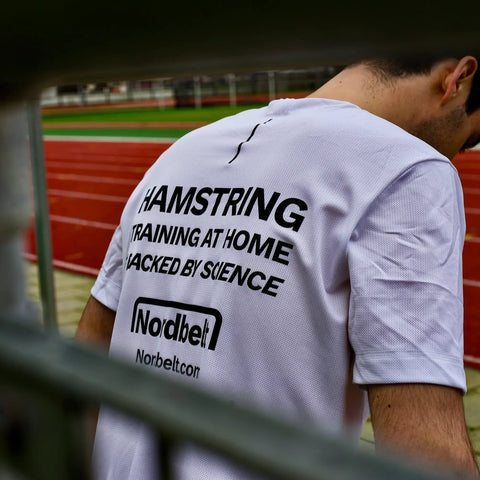
If you have separately chosen Nordic curls at home within that existing strength routine, Nordbelt for Nordic curls at home provides ankle fixation at a suitable anchor point without a training partner. The aid makes that setup practical, but does not replace suitable exercise selection, technique or loading. Planning your marathon requires no purchase.
Take your Nordic curl from the first rep to week 10.
A concrete 7-page plan: build up week by week, without pushing too fast.
- 01A clear week-by-week progression
- 02Technique and the mistakes to avoid
- 03A simple log you will actually use

≤ 51%
✓Backed by research
Van Dyk et al., 2019: meta-analysis of programmes with NHE. Not an effect test of Nordbelt or this protocol.
Open the download page again or check the email we sent you.
Open the download page ↗Practise eating and drinking while running
Fuelling deserves attention at both distances. For the marathon, reconsider what you want to use on the move and how you will carry it. Race day should not be the first time you try eating from unfamiliar packaging or have to combine drinking with running.
A small randomised study in endurance runners investigated repeated practice with carbohydrate intake during exercise. Under that specific testing protocol, gastrointestinal symptoms decreased more in the carbohydrate groups than with placebo. This offers limited support for practising beforehand, but does not determine your personal intake or guarantee a symptom-free marathon (Costa et al., 2017).
Use suitable training sessions to try your intended approach. Record what you used, when, how you carried it and what proved manageable. Avoid changing everything at once if you want to understand what works for you. Also check what will be available along the race route. A sports dietitian can help if you want to establish a personal intake plan or keep experiencing symptoms.
Choose a goal that fits this training block
Your half marathon time is useful information, but not a fixed result for the marathon. In research among recreational endurance runners, a widely used formula for predicting marathon times was often too optimistic. The study does not provide a personal correction you can simply add to your half marathon time (Vickers and Vertosick, 2016).
Include your previous race when discussing a goal, alongside your recent training and how the new block is going. Explain the conditions in which you ran your half marathon too. A favourable race day and a well-executed training block provide different information from a finish time entered into a calculator.
Define what the goal means to you. Is your main aim to gain experience of the distance, or does a time goal fit your preparation? Agree in advance when you will adjust that goal. An estimate then becomes a planning aid, rather than a pace you must maintain at all costs.

Start planning now or make room first?
Use the following options to organise your preparation. They are not scores that determine your medical or physical readiness.
Have a suitable plan drawn up. You can show your recent training, know which times are genuinely available and understand the constraints in your diary. Take that overview to a coach to discuss a plan and date. It makes the conversation concrete; it does not guarantee a finish.
Make room and build consistency first. Your current running routine varies considerably, or a longer session fits only if you repeatedly sacrifice sleep and fixed commitments. Make the week workable first. That may mean adjusting arrangements or choosing a later race before expanding your preparation.
Revisit your goal or training load. Illness, persistent pain or increasing exhaustion are reasons to reassess the schedule. Stop if pain changes your running gait and seek an assessment of what is happening. Pushing harder is not a solution to a plan that no longer fits.
Write down four things: your current running base, available sessions including the time around them, fuelling you still want to practise and what would prompt you to revise your date or goal. That gives you a useful starting point for the next step.
Frequently asked questions
How much time should I leave between my half marathon and marathon?
There is no fixed number of weeks that applies to everyone. First consider whether you have recovered from the half marathon, how consistently you can train afterwards and whether your chosen plan starts at your current level. Choose the date after considering the space you need. A gap in the calendar alone does not show that a training block fits.
Do I need to run the full marathon distance in training first?
Do not use completing the full distance as a standalone test for your marathon. The length of your longest training run belongs within your overall preparation and the way you recover. Discuss that choice within a suitable plan, instead of forcing the distance once to feel certain.
Can I just double my half marathon time?
That does not provide a reliable personal prediction. Your half marathon result is one reference point, but does not tell you how you have absorbed the longer training block or how the marathon will unfold. Treat a calculator as an estimate alongside your current preparation and the conditions, rather than a compulsory finish time.
Do I need gels for my first marathon?
A gel is one possible form of fuel, not a choice this article can make for you. Decide what you want to use on the move and practise it during suitable sessions. Record what works practically and how you respond. A sports dietitian can help with intake questions or recurring symptoms.