

Nordic hamstring curl mistakes: technique and safe setup


Most Nordic hamstring curl mistakes do not happen because the exercise is complicated. They happen because the setup, range or tension is not controlled. Your ankles need to stay fixed low, your hips stay extended, your torso moves as one line and your hands are ready to catch you. If your feet slide, your lower back arches or you force full reps too soon, the exercise becomes messy and unnecessarily heavy. Start with short controlled reps and only build range when the technique stays the same.
In short
A good Nordic hamstring curl is mainly a controlled lowering phase. You kneel, fix your ankles and let your body move forward while the hamstrings slow the motion. Research on Nordic programmes suggests the exercise can support eccentric hamstring strength and injury prevention in sport settings when it is performed consistently and progressed calmly. (van Dyk et al., 2019; Medeiros et al., 2020).
This page is narrower than the main Nordic hamstring curl guide. It focuses on spotting mistakes: what goes wrong, how to correct it and when a regression is smarter than forcing another heavy rep.
Nordic curl mistakes to spot early
The first mistake is thinking a rep only counts if you reach the floor. For most athletes the last half of the movement is much harder than the first half. If you drop through it, you are mostly training a fall with a hand catch. A short controlled lowering phase is better than a long uncontrolled rep. The second mistake is using an anchor that moves. A loose chair, light bench or partner who cannot hold you steadily makes the exercise unreliable. The third mistake is doing too much in the first week; progressive programmes build load over several weeks. (Petersen et al., 2011).
Nordic hamstring curl technique: the basic check
Use this technique checklist before moving to harder versions.
- Knees on a mat or soft surface.
- Ankles fixed low and firmly.
- Hips extended, not sitting back.
- Ribs quiet, trunk lightly braced.
- Hands ready in front of the body.
- Lower only as far as you can control.
The main cue is to move from the knees, not from the hips. Your body does not need to feel rigid, but your hip angle should stay mostly the same. If your hips move back, you shorten the lever and make the exercise easier. That can be a regression, but it is no longer a full Nordic.
For full setup steps, use the Nordic hamstring curl at home guide.
Performing the Nordic hamstring curl safely with a fixed setup
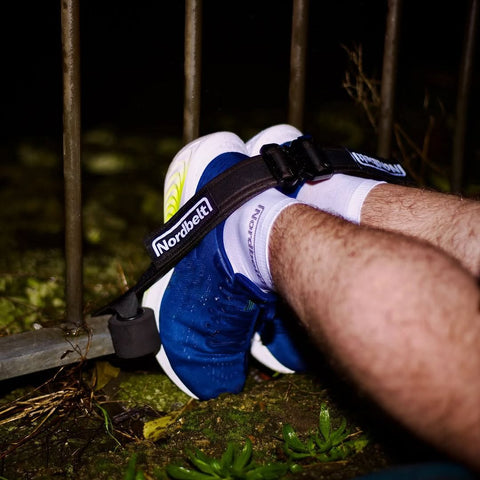
Safe Nordic hamstring curls start at the ankles, not the hamstrings. Test the anchor with your hands before kneeling. Pull in the same direction your body will load it. If the anchor shifts, tilts or comes loose, it is not ready.
Low enough
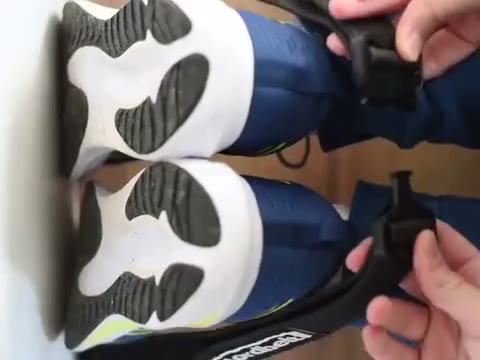
The fixation should stay low around the ankles. If it sits too high, the exercise feels less stable and your posture changes more easily.

Stable enough
The anchor should behave the same under load. A sturdy door setup, training bench, fence or beam can work. If you want the no-bench route, read Nordic hamstring curl without a bench.
Repeatable enough
Building a new improvised setup every session invites different technique. A compact fixed solution can help. Nordbelt can be practical when you want the same low ankle fixation on a door, bench, fence or beam. Follow the how-to guide and test the attachment before your first rep.
Hollow back during Nordic curls: what is happening?
A hollow lower back usually appears when the exercise is too heavy or you try to lower farther than your hamstrings can control. The pelvis tips, the lower back takes over and the movement becomes less controlled. A small natural curve is fine; the issue is a posture change that grows as you lower. Shorten the range, keep the ribs quiet and use your hands earlier.
Nordic hamstring curl too hard: how to scale down
If the Nordic hamstring curl is too hard, keep training but reduce the peak load. Use short eccentric reps, hand-assisted reps, band assistance, slider curls or hamstring walkouts. Use Nordic hamstring curl alternatives when the full version is still too much.

Reviews of Nordic training repeatedly point to adherence and progression: an exercise only helps when athletes can keep doing it and tolerate the load. The best regression is the one you can repeat cleanly. (Goode et al., 2015; Ripley et al., 2021).
Training-week mistakes
Do not place hard Nordics straight after sprint work while you are still learning them. Put them where you are fresh enough to control the lowering phase, start with a low dose and add range or reps only when the next session feels normal. If you train alone, the Nordic hamstring curl without a partner guide fits this route.
FAQ
What are the most common Nordic curl mistakes?
Loose anchoring, rushing to full reps, sitting the hips back, arching the lower back and doing too much volume early are the main mistakes.
What does good technique look like?
Low ankle fixation, soft knee support, extended hips, hands ready and a controlled lowering phase. Stop before the rep turns into a fall.
How do I perform Nordic curls safely?
Test the anchor first, use a mat, start with short range and make sure the feet do not slide or lift.
Is a hollow back always wrong?
A small natural curve is normal. It is a problem when the lower back increasingly takes over because the rep is too heavy.
What if the exercise is too hard?
Use shorter eccentrics, hand support, band assistance, sliders or walkouts until you can keep the same technique across sessions.