

Nordic curls at home: strength or muscle growth?


Use the Nordic curl at home for strength or muscle growth primarily to develop eccentric knee-flexion strength. The exercise may also contribute to muscle growth, but it is not a complete hamstring programme. For strength, mainly track control and range of motion; for muscle growth, combine the Nordic with a broader exercise selection and progressive loading. The real choice is therefore not strength or muscle growth in absolute terms, but the role the Nordic should play in your plan.
Strength and muscle growth require different measures
Strength is about what you can produce or resist with control in a movement. Muscle growth is a change in muscle size over time. These outcomes can occur together, but they are not the same. A harder Nordic is therefore not automatic proof of more muscle mass, and more muscle mass does not show exactly how much of your progress came from the Nordic.
A systematic review and meta-analysis found that Nordic training can increase eccentric knee-flexor strength and fascicle length in the biceps femoris long head. Muscle size was not a primary pooled outcome in this review. The review therefore supports the Nordic as a strength-focused exercise, but cannot establish that it forms a complete hypertrophy routine for all the hamstrings (Medeiros et al., 2020).
A training study in recreationally active male athletes compared ten weeks of Nordic hamstring exercises with a hip-extension exercise. Both groups showed changes in muscle architecture and muscle volume, but the distribution differed by exercise and muscle. The study therefore supports that the Nordic can contribute to muscle growth; it does not prove that one exercise is sufficient for every person or every hamstring muscle (Bourne et al., 2017).
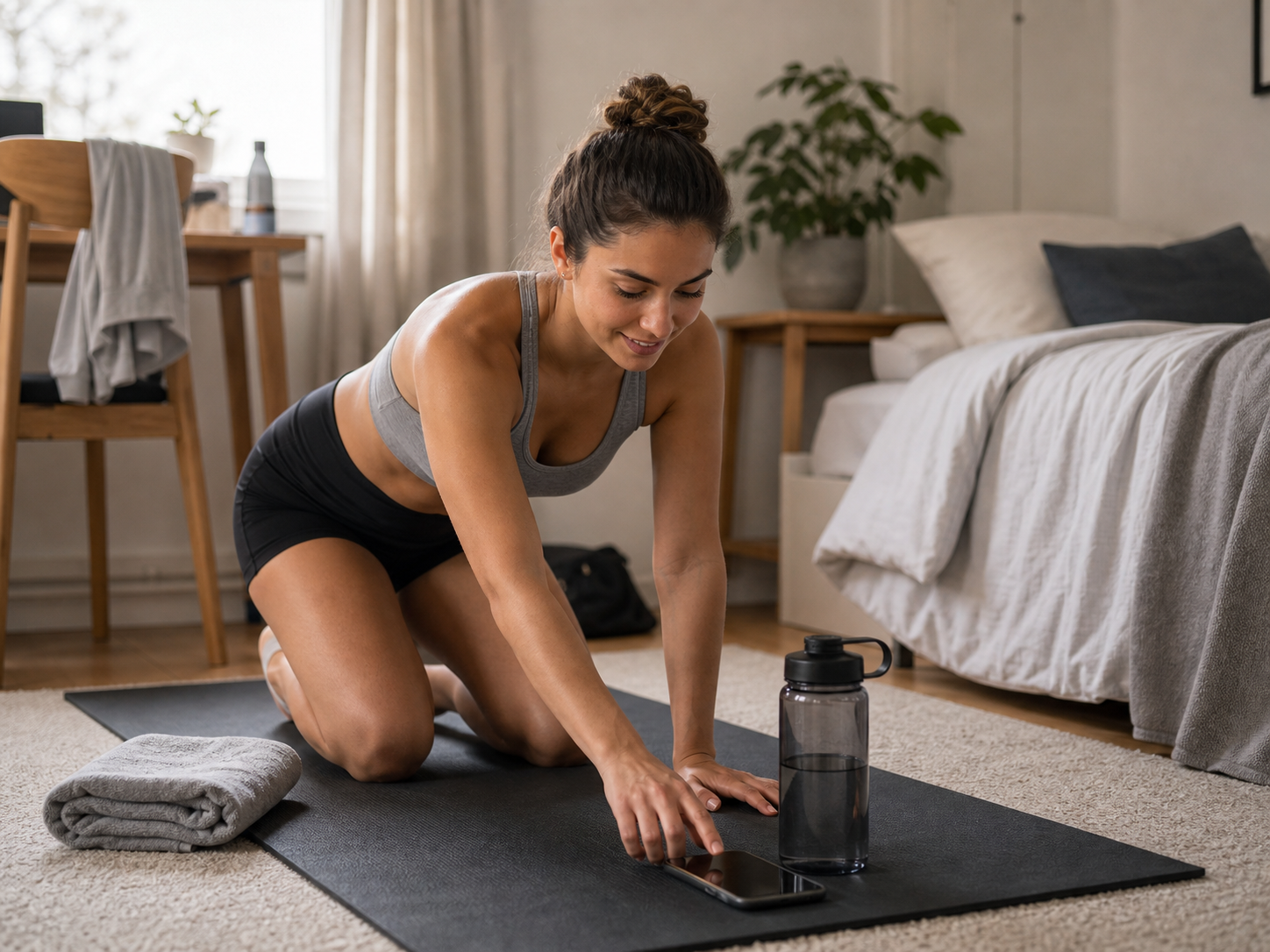

The Nordic goal compass for home training
Use this goal compass before choosing sets, repetitions or frequency. It is an editorial synthesis of the cited studies and practical home conditions, not a researched protocol or a personal programme.
| Primary goal | What the Nordic logically contributes | What to track honestly | What may still be missing |
|---|---|---|---|
| Strength | Focused resistance during knee flexion with fixed ankles | The same regression, assistance, range of motion and execution control | Other movement tasks that your plan deliberately requires |
| Muscle growth | A demanding knee-flexion stimulus as part of a broader plan | Consistent execution, appropriate loading and development over several weeks | Enough programme variety for hamstrings that also work across the hip |
| Combined | One exercise that combines strength work with a potential growth stimulus | Quality in each set first, broader programme outcomes second | A clear division of roles with other exercises and room for recovery |
Choose one primary goal for your next training phase. You do not have to discard your other goal; you are only deciding which signal takes priority when quality, volume and fatigue conflict. For strength, that is usually a comparable, controlled range of motion. For muscle growth, assess the Nordic as one part of the programme rather than isolated proof that every hamstring muscle received enough work.
Ankle fixation for Nordic curls at home
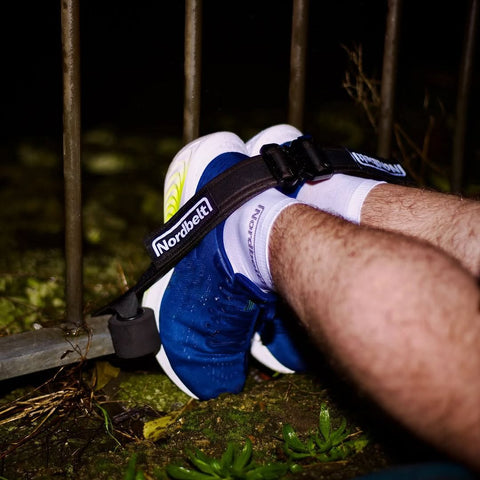
Would you also like to add Nordic curls at home? First check that you have a suitable anchor point, low and symmetrical ankle fixation, comfortable padding for your knees and clear space for the forward path. Test the fixation with light force and choose a regression that lets you resist the descent. Only when this foundation is repeatable can you compare strength or muscle-growth signals meaningfully.
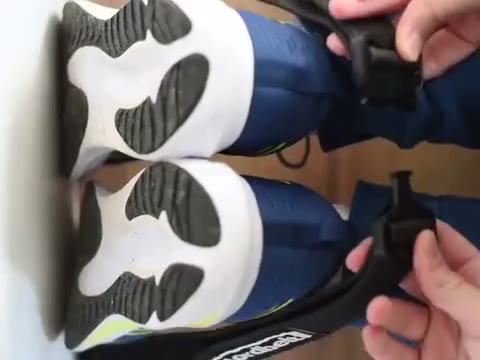
With Nordbelt for Nordic curls at home, you can arrange stable ankle fixation without a training partner or large fitness machine. This solves the practical fixation problem, not the entire training question. The equipment does not choose your primary goal, programme your volume, monitor your technique or replace gradual load selection. Test the anchor, strap position, symmetry, knee padding and clear space before every session.
Take your Nordic curl from the first rep to week 10.
A concrete 7-page plan: build up week by week, without pushing too fast.
- 01A clear week-by-week progression
- 02Technique and the mistakes to avoid
- 03A simple log you will actually use

≤51%
✓Backed by research
Van Dyk et al., 2019: meta-analysis of programmes with NHE. Not an effect test of Nordbelt or this protocol.
Open the download page again or check the email we sent you.
Open the download page ↗Nordic exercise for hamstring strength at home: track quality
When strength is your primary goal, your measure should stay close to the task. Record which assistance or regression you use, the point at which you can no longer resist the descent evenly, and whether your body line remains recognisable. Compare only sessions with the same setup. More repetitions over a shorter, unstable range are not clean progress compared with fewer repetitions over a fixed, controllable range.
The review by Medeiros and colleagues links Nordic training to improvements in eccentric knee-flexor strength, but it does not provide a universal rule for sets, repetitions or frequency for every home athlete (Medeiros et al., 2020). Do not turn the research result directly into a generic programme. First choose a manageable variation, keep one measure constant and change only one difficulty factor at a time.
A useful strength check consists of four questions:
- Did the ankle fixation remain the same during every repetition?
- Could you deliberately resist the chosen range without dropping unexpectedly?
- Were the assistance and regression the same as in the previous comparable session?
- Did you stop when your chosen execution quality changed?
For complete execution guidance and regressions, the guide to the Nordic hamstring curl and hamstring curls remains the technique guide. For its place within a session, use the separate decision guide on Nordic curls as a main block or finisher.
Nordic curls for hamstring growth: respect the programme boundary
For muscle growth, the question is not only whether the Nordic feels demanding. You need to know which task the exercise covers and which parts of your wider plan sit outside it. The Nordic is primarily a knee-flexion task with fixed ankles. The hamstrings also work across the hip, so a purposeful muscle-growth plan is generally not assessed through one exercise or movement pattern alone.
In the study by Bourne and colleagues, changes in the distribution of muscle volume were not identical after Nordic and hip-extension training. The participants, duration and exercises were also specific. Use that result to consider programme variety, not to claim a guaranteed combination, optimal frequency or personal growth expectation (Bourne et al., 2017).
For a muscle-growth goal, keep these three levels separate:
- Exercise: can you perform the Nordic consistently within the chosen regression?
- Programme: does your plan deliberately include the movement tasks you want to train?
- Outcome: assess changes over an appropriate period without treating one session or a sensation in the muscle as proof.
If you want to distinguish between different eccentric options, continue with the guide for eccentric hamstring exercises. This page stays focused on the Nordic's role and does not become a broad exercise list or complete hypertrophy programme.
Combine strength and muscle growth without blurring the goal
A combined goal only works when you decide in advance which signal is decisive. For example, prioritise execution quality: once you can no longer resist the chosen range with control, the set ends, even if you wanted to accumulate more fatigue. Then assess at programme level whether the Nordic leaves enough room for other planned hamstring tasks.
Use this compact decision sequence:
- Write down one primary goal for the training phase: strength, muscle growth or combined.
- Choose one Nordic measure that fits that goal.
- Record which other movement task the Nordic does not need to replace.
- Test your home setup and regression before starting the working sets.
- Do not change range of motion, assistance, volume and session position at the same time.
- Evaluate the Nordic both as an individual task and as part of the wider plan.
These two cited sources do not establish one universally best home-training structure. The studies offer useful direction on strength, architecture and muscle size, but no personal weekly programme. A goal compass therefore helps you choose what to observe; it does not predict an outcome.
When to stop before adjusting the goal
Stop if you experience unexpected sharp pain, new swelling, numbness, clear loss of strength or an anchor that shifts. Do not try to solve these signs by renaming the goal from strength to muscle growth, or vice versa. Have new, severe or persistent symptoms assessed by an appropriate healthcare professional.
This page does not provide a diagnosis and is not a rehabilitation or prevention protocol. If you have an existing symptom, a recent injury or are returning to training, the choice of exercise, load and range of motion belongs within the personal advice of the professional involved.
Choosing a Nordic curl goal: the practical decision rule
Choose strength when you mainly want to use the Nordic to track controlled eccentric knee-flexion strength. Choose muscle growth when you deliberately place the Nordic as one stimulus within a broader hamstring plan. Choose combined when you want to support both outcomes, but let execution quality and programme variety guide the decisions separately.
To check the door, strap and starting position before your home session, use the Nordbelt guide for Nordic curls at home. For a complete home setup check, the separate guide on Nordic hamstring curls at home remains available.
Frequently asked questions
Is the Nordic curl mainly a strength exercise?
The Nordic curl strongly suits eccentric knee-flexion strength because you resist a forward movement with fixed ankles. Research supports strength and architectural adaptations after Nordic training, but it does not prescribe a universal home programme (Medeiros et al., 2020). Use a fixed regression and range of motion as your measure.
Can Nordic curls build muscle?
Nordic training can contribute to changes in muscle architecture and muscle volume. The available cited study also shows that adaptations can differ by exercise and muscle (Bourne et al., 2017). Treat the Nordic as a possible part of a broader muscle-growth plan, not as a complete routine or guarantee.
Is the Nordic curl alone enough for all the hamstrings?
Not as a general rule. The Nordic emphasises knee flexion with fixed ankles, while the hamstrings also work in hip-focused tasks. The tasks your plan requires depend on your chosen goal and the rest of your training. This page does not provide a complete exercise programme.
How do you measure progress with Nordic curls at home?
Compare the same ankle fixation, regression, assistance and range of motion. Record how far you can resist evenly and stop when your chosen execution quality changes. Do not change several factors at once, because then you cannot tell which part actually improved.
Do strength and muscle growth require a different Nordic programme?
The priorities differ, but there is no universal programme to give here. For strength, the measure stays close to control and range of motion. For muscle growth, also assess overall programme variety and progressive loading. Choose one primary goal and align sets, frequency and other exercises with your wider plan and capacity.