★ 4.6
What does Nordic hamstring strength per kilo mean for a young footballer?

One player records 216 newtons and another records 252. Work through their test sheets to see how both can finish on 4.5 N/kg, and which numbers to keep for next time.
FREE 10-WEEK TRAINING PROTOCOLSend my free protocol ↓Your heavier teammate records more newtons than you on the Nordic curl. If you did the same test and are looking at the same column, he produced more force. You may still have the same strength per kilo. That distinction matters for young footballers who are still growing. Check that both scores are for the same measurement, such as peak force from the right leg. Then divide each player’s force in newtons by his own body weight in kilograms on the day of the test.
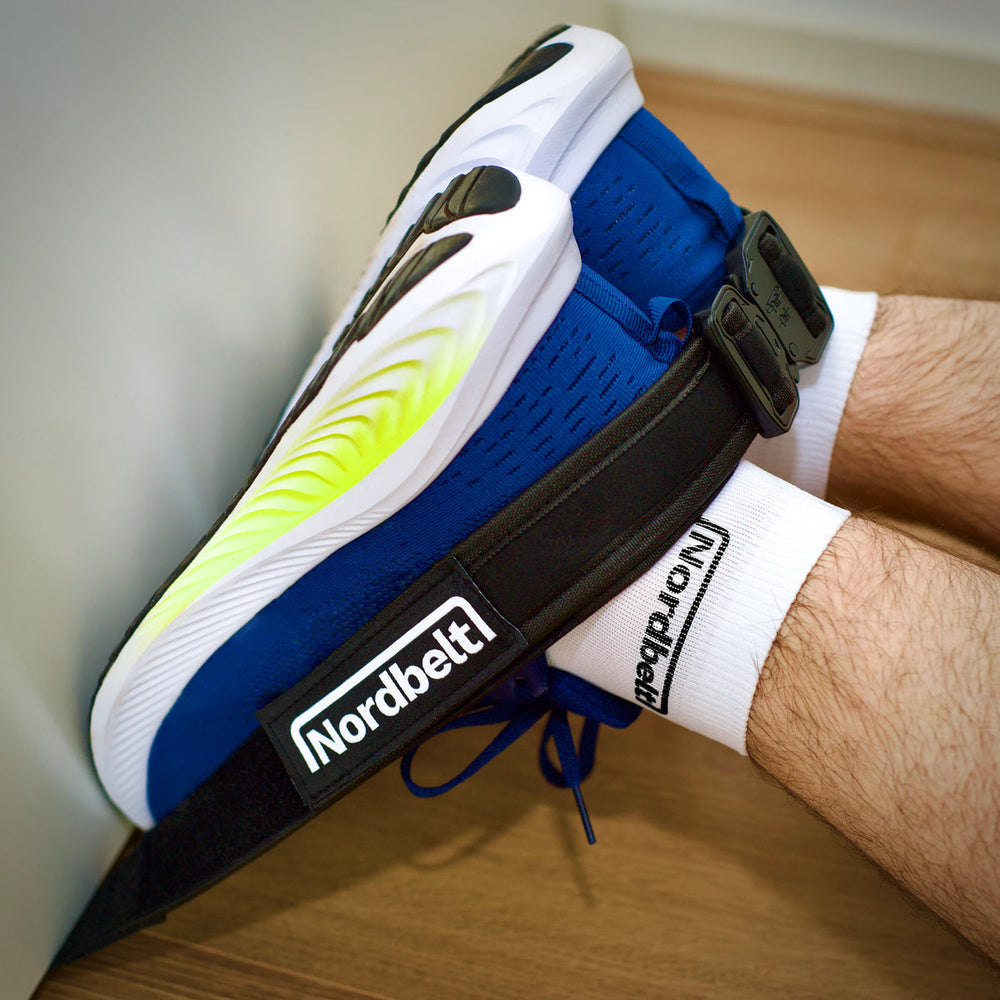
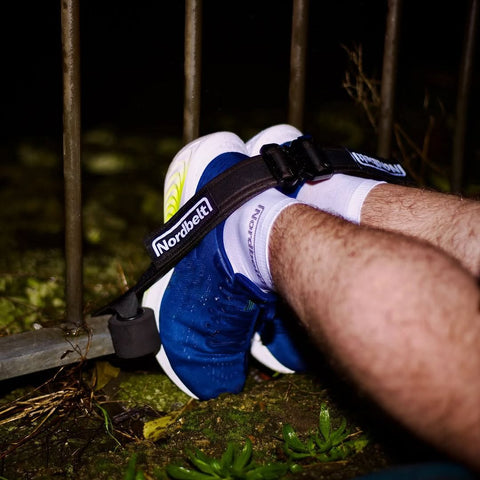
Already do Nordics at the club? If your coach wants to set up the exercise when there’s nobody to hold your ankles, see how to secure your ankles at a door, bench or fence with Nordbelt. The three short videos show how to pick a solid anchor, close the buckle and adjust the strap. It takes sensors to record force in newtons during the club test. An ankle strap on its own gives you no force reading.
What does the column heading on your test sheet say?
For a Nordic curl, you kneel with your ankles held in place and use your hamstrings to control the movement as you lean forwards. At a club test with force sensors, your coach can see how hard you pull against the ankle supports as you lower yourself. Peak force is the highest force the sensor records. The N after the number stands for newtons.
Read the heading above the number. It might say ‘left’ or ‘right’, ‘average of both legs’ or ‘total’. Say your left leg recorded 220 N and your right recorded 240 N. The average of those two peaks is 230 N. You can compare that 230 with your teammate’s average. If his sheet only shows a right-leg result, ask for yours from the right as well. Dividing by body weight won’t make different columns comparable.
Check how the coach has combined your attempts, too. Does the score show your highest peak that day, or the average of the peaks from three attempts? If the heading doesn’t say, ask to see one set of efforts in the report. You can then see which number from the set ended up on your card.

How can 252 newtons come out the same per kilo as 216?
Take two made-up results from the same club test. Both force columns are headed ‘right-leg peak’. Sam weighs 48 kg on the test day and records 216 N. Dani weighs 56 kg and records 252 N. There’s a difference of 36 N on the screen. If you’re asking who produced the greater force in this test, the answer is Dani.
- Sam divides 216 by 48. That gives 4.5 N/kg.
- Dani divides 252 by 56. That also gives 4.5 N/kg.
Dani produced more force with his right leg. For each kilogram of body weight, the two players came out level. To check the calculation, multiply 4.5 by each player’s weight. That takes you back to the force on his test sheet. We’ve used 4.5 here to make the arithmetic easy. It isn’t a score you need to aim for.
What if you’ve grown since your last test?
Put two of your own results side by side. Suppose you weighed 50 kg at your first test and recorded 240 N with your right leg. A few months later the sheet says 55 kg and 264 N. You produced 24 N more braking force during the same test. The result per kilogram stayed at 4.8. If you’d only looked at the last column, you’d have missed the rise in force.
In a study by Jeanguyot et al., 2023, boys at a sports academy took a Nordic strength test. The researchers compared age groups and looked at results from adult professional footballers in Qatar. At the academy there were clear differences in absolute force between older and younger groups. Once the researchers took body weight into account, the group averages from under-14 to under-18 were much closer. The academy included track and field and other sports as well as football. The figures describe several groups of athletes.
Keep the date and the body weight from that test day beside each result. What if all you have from your previous test is the force in newtons? Keep that number and leave the old N/kg box blank until your coach can find the weight recorded at the time. Using your weight today would answer a different question.
Take your Nordic curl from the first rep to week 10.
A concrete 7-page plan: build up week by week, without pushing too fast.
PDF7 pagesStraight to your inbox
- 01A clear week-by-week progression
- 02Technique and the mistakes to avoid
- 03A simple log you will actually use

Open the download page again or check the email we sent you.
Open the download page ↗≤ 51%
✓Backed by research
Van Dyk et al., 2019: meta-analysis of programmes with NHE. Not an effect test of Nordbelt or this protocol.
Does the score tell you who’s quickest?
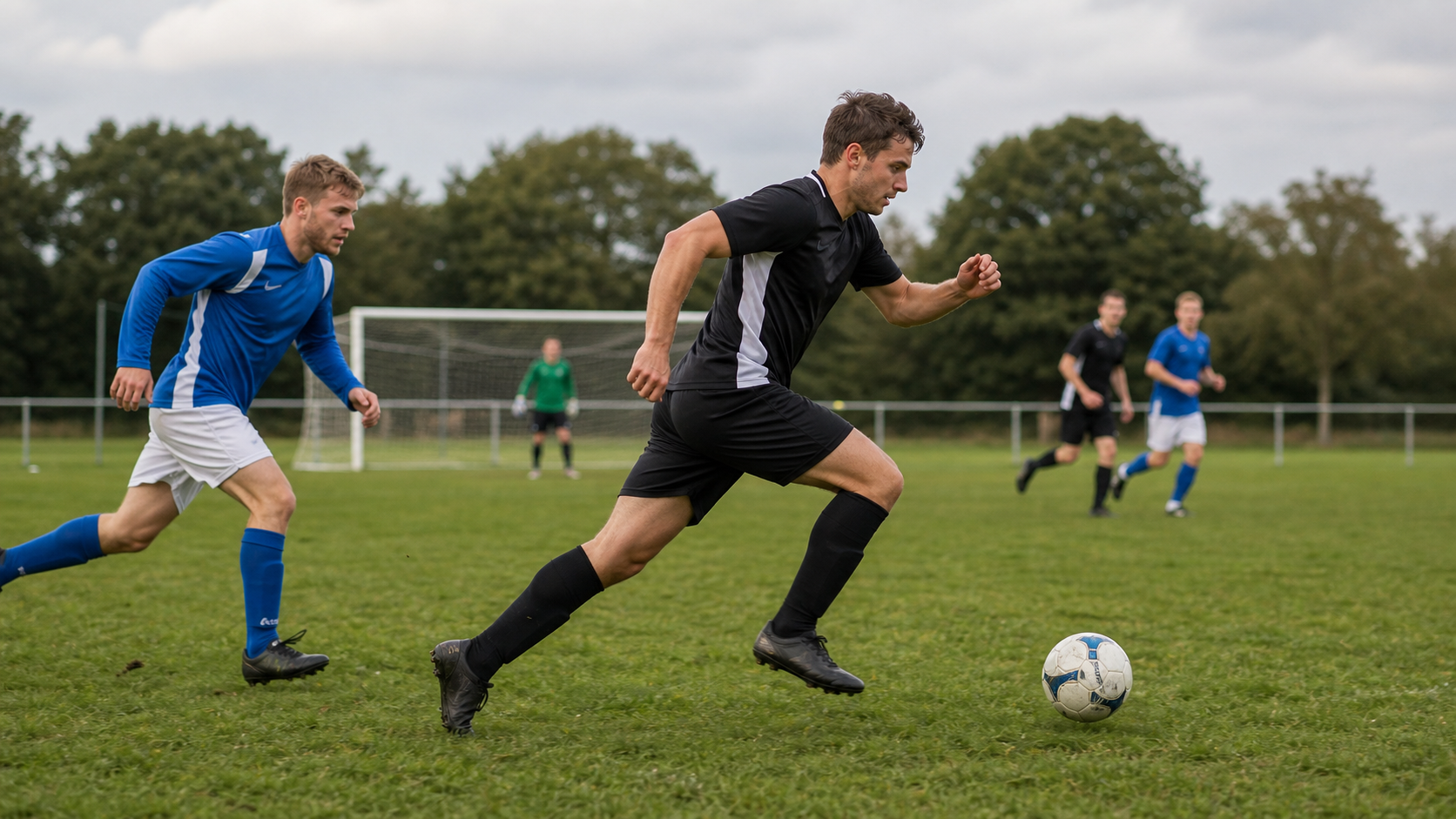
Markovic et al., 2020 compared 133 highly trained young footballers and 22 adult players. The biggest difference in absolute Nordic force between adjacent youth age groups was between the under-15s and under-16s. In N/kg, they found no statistically clear difference between the age groups. They were comparing different players. An under-15 player can’t use that group difference to tell what he’ll score next season.
Of the young players, 119 also ran a 20-metre sprint. Within that group, relative Nordic strength was related to sprint time. It won’t tell you what time you’ll run next week. To see whether you’ve got quicker, compare times over the same distance with the same start and timing method. Keep your strength result alongside them. For a closer look at the two exercises, read what sprinting and Nordic curls each train.
What should you take to your next chat with the coach?
Write down the date, left or right leg, how the club reported the result, force in N and your body weight at the test. Add the value in N/kg. One line from our example would read ‘Sam, right leg, best peak, 216 N at 48 kg, 4.5 N/kg’. Ask whether the setup and number of attempts will be the same next time. If the club changes the test or the way it reports the results, start a new set of entries in your notes.

On an ordinary training day you can still keep track of how far you lower yourself under control. With your coach, pick an anchor that stays put when you give it a gentle pull and leave space in front of you for your hands. If the bench lifts or slides, choose a fixed anchor before you start. The guide to a stable Nordic curl setup shows what to check at a bench or a door. If you film a rep from the side, label the entry ‘video’. The angle where you start to lose control describes something you can see on the recording. For another result in newtons, you’ll need a new force measurement at the club.
Frequently asked questions
Can I divide my left-leg result by my full body weight?
Yes, if the club reports each leg separately and uses N/kg to mean that leg’s force divided by your body weight. If your left leg recorded 216 N and you weighed 48 kg, that gives 4.5 N/kg for the left leg. Use the same calculation for your right leg.
My card just says ‘260’. What can I do with that?
Ask for the unit and the column it came from. Is it 260 N from one leg, an average, or something else? Once you have that information and your weight on the test day, you can fill in the line and find it again later.
What score do I need to make the squad?
These two studies don’t give a selection cutoff for an individual player. Their averages describe the groups they looked at. Ask your coach what you’re trying to track across your own tests. That will help you decide what to record at the next one.
Can I use my hamstring bridge count if I missed the club test?
Give it a separate line. In a single-leg hamstring bridge test you count repetitions. Even if you know exactly what you weighed that day, you can’t convert the count into the force an ankle sensor would record during a Nordic curl.