

Training hamstrings with a kettlebell: 6 exercises and safe progression


Training your hamstrings with a kettlebell works best when the kettlebell teaches a calm hip hinge, not when it turns every set into a fast swing. Start with the kettlebell Romanian deadlift, add deadlifts, single-leg variations and bridges, and only bring in swings once the hinge is stable. Keep your back quiet, keep your knees slightly bent and keep the kettlebell close to your body. Increase weight or speed only when your hamstrings feel normal the next day. For heavier eccentric hamstring work, sliders or assisted Nordics can come later.
Quick guide
A useful kettlebell hamstring session starts with control. Because the weight hangs low, you can quickly feel whether you are moving from the hips or lifting from the lower back. That makes the kettlebell practical for Romanian deadlifts, deadlifts from the floor, single-leg work and controlled bridges. Swings can be valuable later, but they are not the first step if your hamstrings still tighten easily.
If you want the wider exercise menu first, use the guide to hamstring exercises. If you have two separate weights instead of a kettlebell, training hamstrings with dumbbells is the closer match. This article stays deliberately narrow: how do you use one kettlebell well for hamstring strength?

Why a kettlebell works for hamstrings
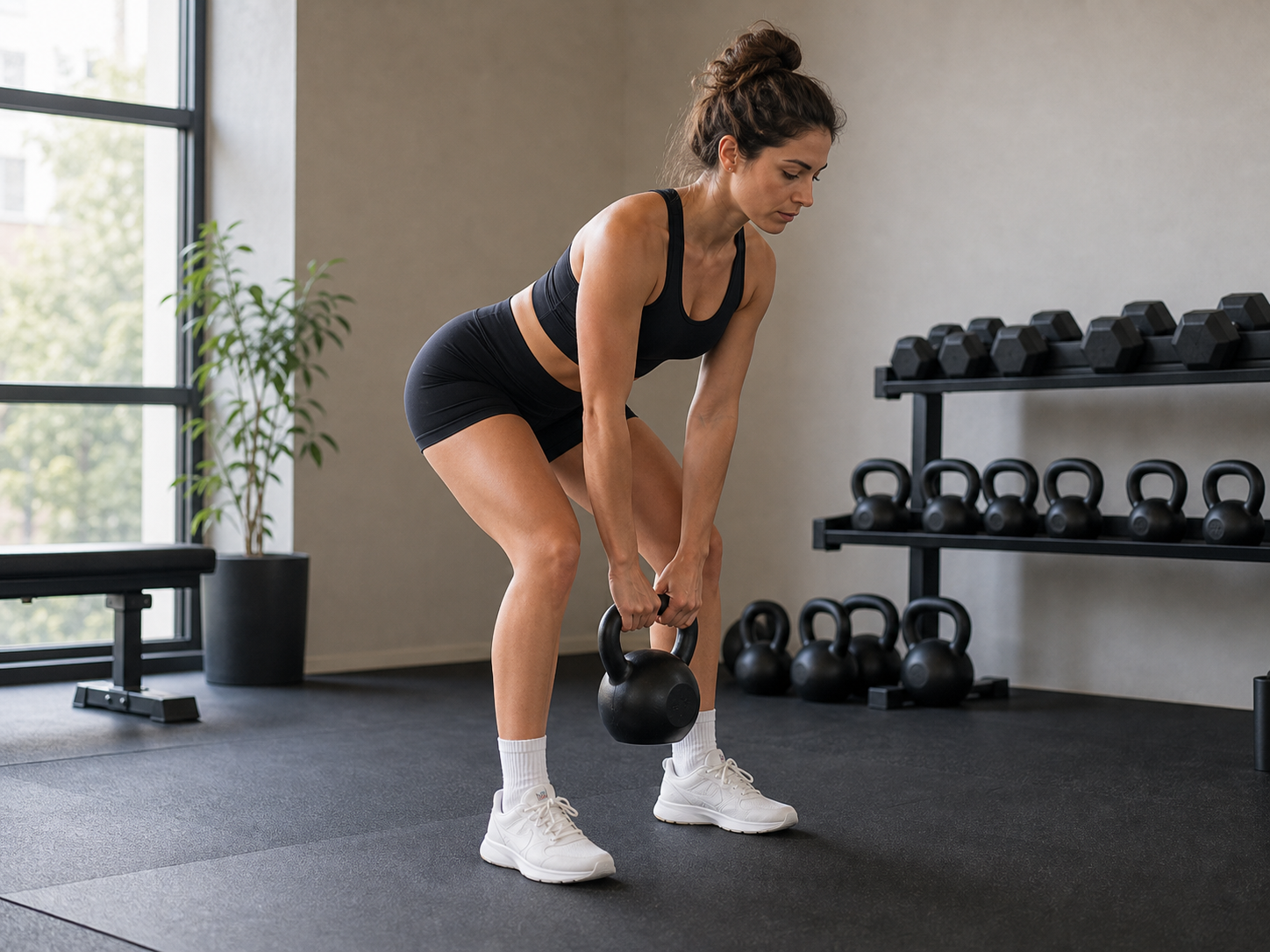
A kettlebell is especially useful for hip-dominant hamstring training. In a good hinge, your hips move back, your torso stays long and you feel tension on the back of the thigh. The kettlebell keeps that pattern simple because you can hold the weight with two hands and keep it near your centre line.
The main mistake is assuming that every kettlebell movement automatically trains the hamstrings. A messy swing can become a lower-back or shoulder exercise. A Romanian deadlift that goes too deep can do the same. Stop at the point where you feel hamstring stretch and tension while your back position stays the same. Range only helps when you keep control.
Research on hamstring exercise selection shows that eccentric variations can load the hamstrings differently and may create different adaptations. Exercise choice should therefore depend on goal, technique and current tolerance, not only on which movement looks hardest (Guruhan et al., 2021).
Kettlebell hamstring exercises: the base
Use these three kettlebell hamstring exercises as your starting block.
- Kettlebell Romanian deadlift. Hold the kettlebell with two hands. Push the hips back, let the bell travel close to your legs and stand up slowly. Do 2 to 3 sets of 8 to 10 reps.
- Kettlebell deadlift from a raised start. Place the kettlebell on a block or low platform if the floor is too deep. This helps you lift without rounding your back.
- Kettlebell glute bridge. Place the kettlebell carefully on the hips, plant your feet firmly and drive up smoothly. Hold the top for one second and lower with control.
This base fits well next to a home programme. In hamstring exercises at home you will find more options without machines; use the kettlebell as extra load, not as a reason to make every set heavier.
Take your Nordic curl from the first rep to week 10.
A concrete 7-page plan: build up week by week, without pushing too fast.
- 01A clear week-by-week progression
- 02Technique and the mistakes to avoid
- 03A simple log you will actually use

≤51%
✓Backed by research
Van Dyk et al., 2019: meta-analysis of programmes with NHE. Not an effect test of Nordbelt or this protocol.
Open the download page again or check the email we sent you.
Open the download page ↗Single-leg kettlebell control
Once the regular Romanian deadlift feels steady, add single-leg control. The single-leg kettlebell Romanian deadlift is the key progression. Hold the kettlebell in the hand opposite the stance leg, or hold it with both hands if that feels calmer. Let the free leg move back as a counterbalance.
Balance is not the main goal. If the foot wobbles, the hip opens or the back rounds, simplify the exercise. Use a wall for light support, reduce the range or use less weight. Add load only when you can complete three controlled sets without losing position.
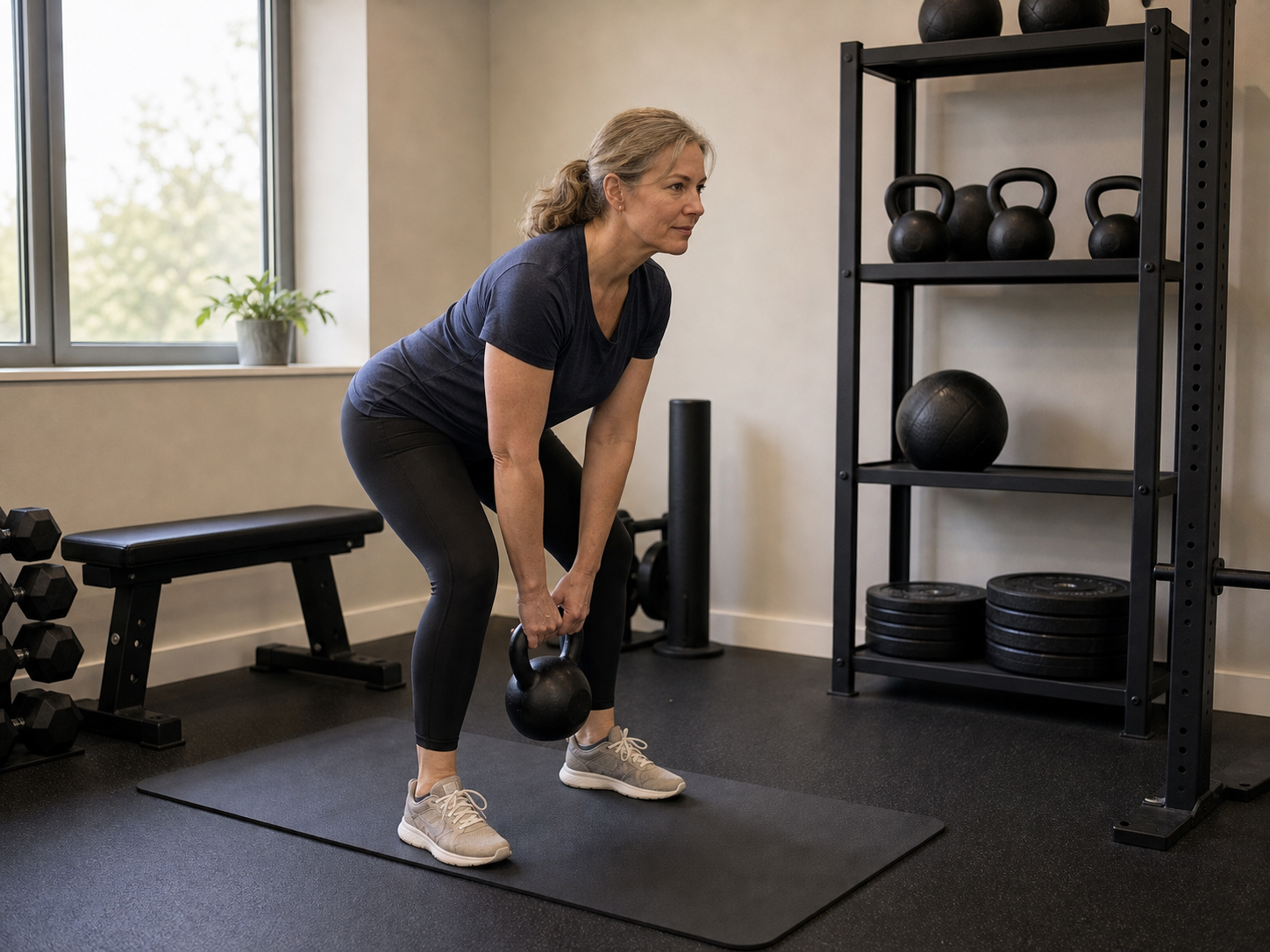
A second single-leg option is the kettlebell reverse lunge. It is not a pure hamstring drill, because the glutes and thighs help as well, but it is useful for control, force production and stair-like patterns. Hold the kettlebell at the chest or by your side, step back slowly and return through the front leg.
Getting stronger without forcing it
Building stronger hamstrings with a kettlebell needs a clear order: technique first, then volume, then weight, and only after that speed. Choose two exercises per session. For example, use Romanian deadlifts and glute bridges on day one, then single-leg RDLs and reverse lunges on day two. Leave about 48 hours between harder hamstring sessions if soreness tends to linger.
A simple four-week structure works well. In week one, do two light sets per exercise and stop well before fatigue. In week two, move to three sets if the first week felt good. In week three, add a little weight while keeping the same technique. In week four, add either a single-leg variation or short swing technique sets.
The kettlebell swing comes in only after the hinge is stable. Do not start with maximum speed. Use short sets where the hips do the work and the arms simply guide the bell. Recent EMG research included the kettlebell swing among functional hamstring exercises, which makes technique and dosing even more important (Gulgosteren et al., 2025).
From kettlebell to sliders or assisted Nordic curls
A kettlebell mainly trains the hip-dominant side of the hamstrings. For a more complete programme, add knee-dominant hamstring loading later. Slider curls, hamstring walkouts and assisted Nordics are good options. The guide to eccentric hamstring exercises explains how to build that braking phase gradually.

The Nordic hamstring curl is a strong but demanding next step. Reviews of Nordic hamstring training show that eccentric strength and muscle architecture can improve, and programmes that include Nordic hamstring exercises have shown favourable effects on hamstring injuries in sport populations (Medeiros et al., 2020; van Dyk et al., 2019). For most people the practical route is simple: kettlebell control first, sliders or assisted Nordics next, and full Nordics only after that.
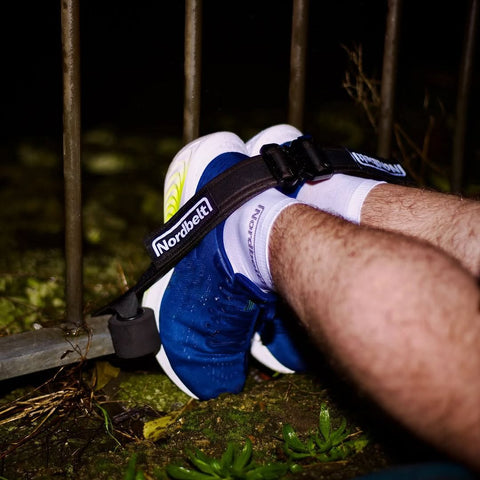
If you want to add assisted Nordics, you need a low and reliable ankle fixation. The Nordic hamstring curl guide explains the exercise. The how-to guide shows how to set up Nordbelt. Look at Nordbelt once your kettlebell base is stable and you want a fixed setup for further eccentric progression.
Frequently asked questions
Which kettlebell hamstring exercises are best?
Start with the kettlebell Romanian deadlift, a raised-start kettlebell deadlift and a glute bridge. Then add single-leg Romanian deadlifts, reverse lunges and, later, swings. Together they build hip strength, control and hamstring tension.
How heavy should the kettlebell be?
Choose a weight you can move for 8 to 10 calm reps without losing back position. The last reps may be work, but they should not become sloppy. If you mainly feel your lower back, the kettlebell is too heavy or the range is too large.
Can I do kettlebell hamstring exercises at home?
Yes. One kettlebell and some floor space are enough for Romanian deadlifts, raised-start deadlifts, bridges and light single-leg variations. If you later add Nordics or assisted Nordics, test the anchor point first and begin with a short range.
Is the kettlebell Romanian deadlift good for hamstrings?
Yes. It is one of the most logical kettlebell hamstring exercises because it trains the hip hinge, trunk tension and hamstring loading at the same time. It works best when the kettlebell stays close and you stop before the back position changes.