

Nordic hamstring curl without a bench: safe home setup


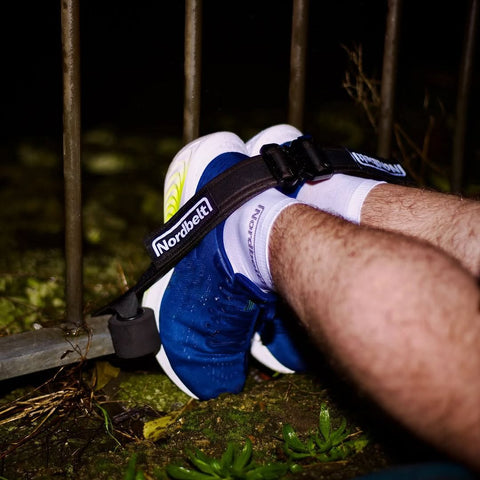
A Nordic hamstring curl without a bench can work well, but the bench is not the real requirement. What you need is a low anchor point that holds your ankles in place while your body leans forward. Use a door setup, a fixed rail, a beam or a compact tool that does not move under load. Start on the floor with knee padding, a short range and your hands ready to catch the movement.
In brief
The Nordic hamstring curl is an eccentric hamstring exercise: you kneel, secure the ankles and lower the body under control. Research on Nordic training supports its role in eccentric strength and hamstring injury risk reduction when the dose is built gradually (Medeiros et al., 2020; van Dyk et al., 2019).
If you want the full exercise guide first, read the main Nordic hamstring curl guide. This article is narrower: how to set up the movement without a training bench, without guessing with loose furniture or unstable fixes.
What you need for a Nordic curl without a bench
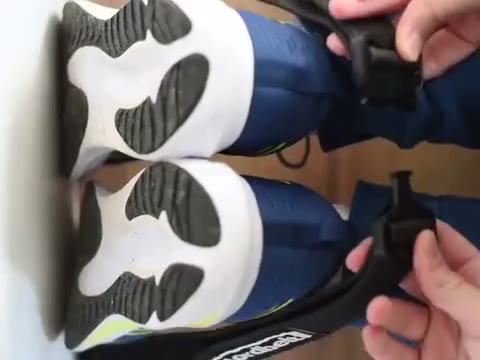
You need a low anchor that does not shift, a strap or device that keeps the ankles fixed, padding under the knees and enough space for the hands to land. A large Nordic bench or GHD can be useful, but it is optional. The important point is that the feet do not lift, slide back or rotate when the lever becomes heavy.
Home setup without a bench
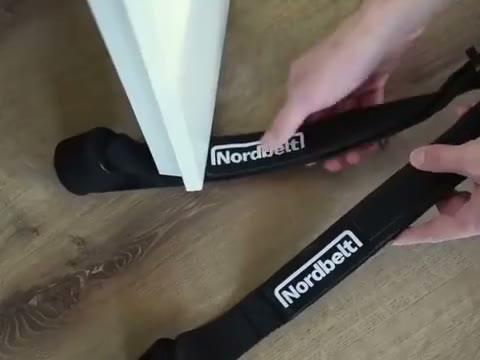
At home, a door setup is often the most practical option. Use only a door that closes away from you, shuts fully and feels solid. Test the strap with your hands before kneeling. If the door opens toward you, moves in the frame or feels uncertain, choose another anchor.
A second option is a fixed point outside or in a garage, such as a rail, beam or post. Pull hard in the same direction as the exercise. If it moves, it is not suitable. For broader door, bench and rail options, see the home Nordic curl setup guide.
How to test the anchor
Before every set, pull the setup hard with your hands, check the direction of force and confirm that the ankles stay low. The Nordic pulls backward and slightly upward, so an anchor that only feels strong straight down may still slip. Stop if the feet creep, the heels lift or the strap moves over the shoes.
If you train alone, the guide to Nordic curls without a partner fits this route. Nordbelt can also help when you want a repeatable Nordic curl anchor for a door, rail or beam. Use the how-to guide for the exact attachment steps.
Floor technique and regressions
Begin on a soft surface. Keep the hips extended, ribs quiet and hands in front of you. Lower only as far as you can control. Useful regressions are a short eccentric rep, an early hand catch, a band-assisted rep or only the lowering phase. Two sets of three to five controlled reps are enough for many beginners.
Progressive Nordic programmes are usually built across weeks. A football trial found fewer hamstring injuries after a gradual Nordic programme, but that does not mean a home trainee should force full reps on day one (Petersen et al., 2011).
A simple first two-week plan
Use the first sessions to learn the setup, not to prove strength. In week one, do one or two sessions with two sets of three short lowering reps. Stop each rep while you still feel in control. In week two, keep the same number of sets and add only a little more range if the previous session did not leave heavy soreness or tightness during walking.
Keep sprinting, heavy hinging and full Nordics separate at first. The exercise is demanding because the body acts like a long lever. A small change in range can make the rep much harder. That is why setup quality, hand support and recovery matter more than adding volume quickly.
Where Nordbelt fits
Nordbelt is useful when the anchor problem is the limiting factor. It does not make the Nordic easy, and it should not replace a gradual progression. Its value is that the low ankle fixation is repeatable: the same strap position, the same pull direction and less time spent improvising before each set. That consistency makes it easier to compare one session with the next.
When the setup is not safe
If the anchor is not reliable, choose an alternative before forcing the Nordic. Slider curls, hamstring walkouts, light Romanian deadlifts and assisted Nordics train similar control with less peak load. Use the Nordic hamstring curl alternative guide when the full movement is too heavy, and the Nordic curl equipment comparison when you mainly want to compare benches, machines and compact tools.
Common mistakes
Do not use a chair that can slide. Do not treat a bench-free setup as a preparation-free setup. Do not chase full range before you can control a short lowering phase. Start once or twice per week and only add volume when normal training still feels fine the next day.
FAQ
Can I do a Nordic hamstring curl without a bench?
Yes, if the ankles are fixed by a stable low anchor. The bench is optional; the anchor is not.
What is the safest anchor?
The safest anchor is the one that does not move under the exact pull of the exercise. Test it hard before kneeling.
Can I do the Nordic curl on the floor?
Yes. The floor or a mat is the normal base. Protect the knees and keep the hands ready.
Do I need Nordbelt?
No. You need a reliable low anchor. Nordbelt is practical when you want the same setup without a bench or partner.