

Goblet squat: choose your stance, depth and starting weight


A goblet squat is a squat in which you hold one kettlebell or dumbbell at your chest with both hands. Bend your knees and hips, keep your feet on the floor and lower to a depth from which you can stand up with control. Start with a light weight that also feels comfortable to grip. Your starting weight and depth should suit your execution; a fixed number of kilos or a compulsory deep squat cannot replace that check.
What do you need for a goblet squat?
Use one weight you can hold securely with both hands. With a kettlebell, grip the sides of the handle with the bell below your hands. With a fixed dumbbell, you can support the upper head while the dumbbell hangs vertically. Do not use a loose plate or an adjustable dumbbell whose parts could move when held this way.
Keep the weight close to your chest, with your elbows pointing down. Choose equipment you can both pick up and put down.
Use a dry, clear surface and shoes that give you a stable footing. If you are unsure about footwear, read the separate explanation of running shoes for strength training.
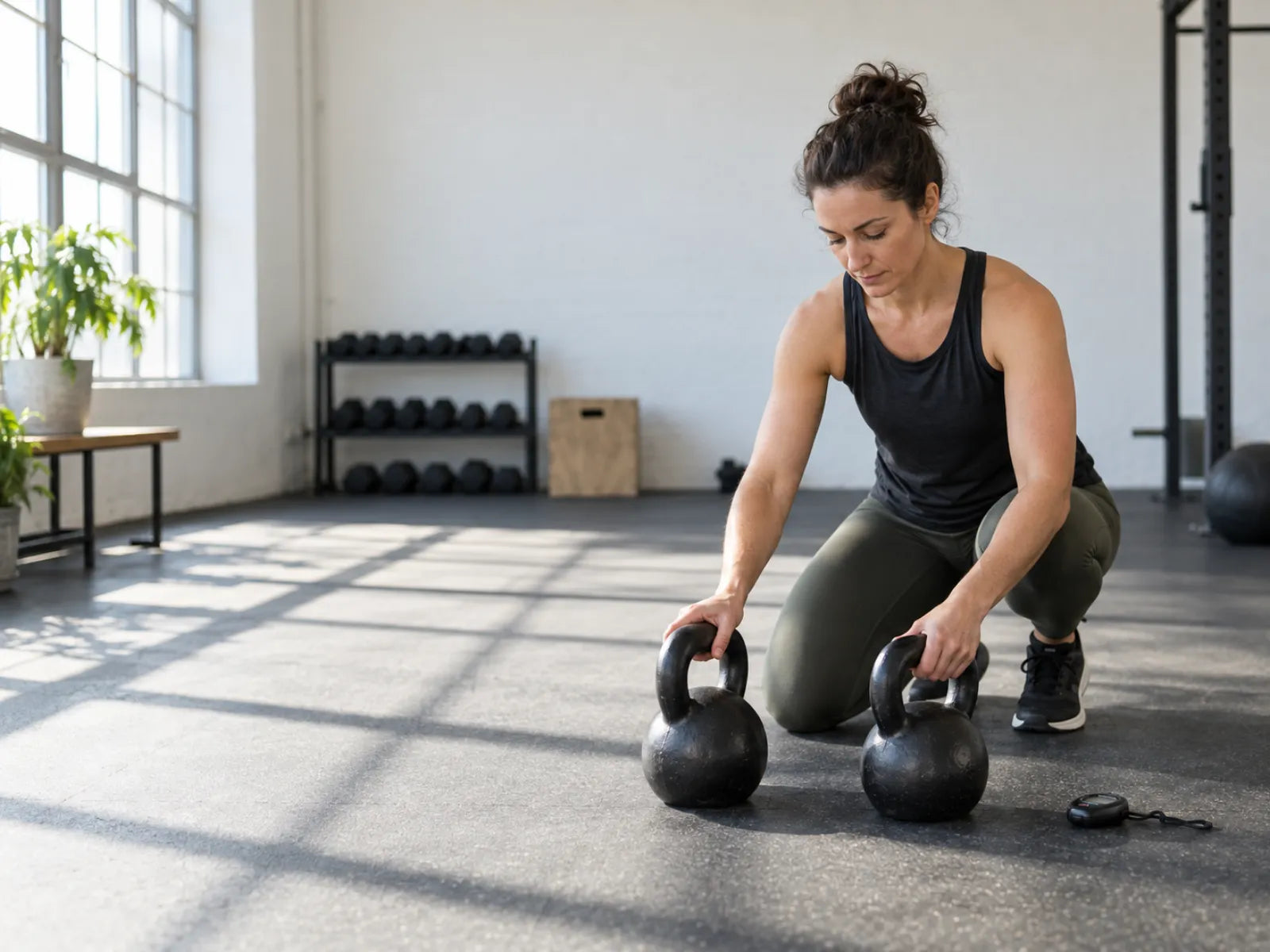
This library photo shows equipment preparation. For the goblet squat, choose one of the weights; the photo shows neither execution nor a recommended weight.

How to perform the goblet squat
Start with your feet roughly hip- to shoulder-width apart, turning your toes slightly out if that feels comfortable. This is a starting position to try, rather than an exact stance everyone must share.
- Set your position. Hold the weight close to your chest, look ahead and brace your trunk without holding your breath for a prolonged time.
- Lower with control. Bend your knees and hips together. Let your knees follow roughly the direction of your toes, keeping your heels and forefeet in contact with the floor.
- Choose your endpoint. Stop where you still control the weight, foot contact and movement. Do not force your knees out with your elbows.
- Stand back up. Push against the floor and extend your knees and hips. Keep the weight at your chest and finish upright without leaning backwards.
Your trunk need not stay perfectly vertical, and your knees need not stay behind your toes. Avoid falling forward. Ask a trainer to watch if you are unsure.
How deep should you go?
Choose a depth you can repeat with the same control. Thighs parallel to the floor is a familiar reference point, not a mandatory minimum. Trunk and lower-leg position and squat depth change mechanical loading. A biomechanical commentary discusses these factors, but does not establish the ideal goblet squat depth for every beginner (Straub and Powers, 2024).
If your heel lifts or your posture changes suddenly at the bottom, first practise with less depth or weight. Do not force extra depth. Sharp pain, dizziness or loss of control is a reason to stop the set; persistent symptoms need individual assessment.
Take your Nordic curl from the first rep to week 10.
A concrete 7-page plan: build up week by week, without pushing too fast.
- 01A clear week-by-week progression
- 02Technique and the mistakes to avoid
- 03A simple log you will actually use

≤51%
✓Backed by research
Van Dyk et al., 2019: meta-analysis of programmes with NHE. Not an effect test of Nordbelt or this protocol.
Open the download page again or check the email we sent you.
Open the download page ↗What starting weight should you choose?
Start with a few slow squats without weight. Then pick up a light weight and try a short set. First find out what you can repeat, rather than prove how much you can lift.
Check the set against these practical criteria: you keep a secure grip, reach a similar depth and stand up with control each time. Choose a lighter weight if your hands or arms are the main difficulty. Do not go heavier solely because your legs could do more: the holding position is part of this exercise.
Increase only when your current execution is repeatable and suits your training goal. Use a small available increment and check again. Keep depth and execution as consistent as possible when comparing weights. To record how many repetitions you think you have left, the explanation of RIR in strength training can help make that estimate specific.
What should you change if the trial set does not work?
Change one thing at a time and reassess. These are practical trial-set choices, not a diagnosis or a personal programme.
| What you notice | First adjustment | What to check again |
|---|---|---|
| The weight pulls away from your chest | Choose a lighter weight | Can you keep it close without losing your grip? |
| Your feet slide or your heels lift | Try less depth and check the surface | Does foot contact stay consistent throughout the repetition? |
| You lower further than you can rise with control | Practise a shorter movement | Can you lower slowly and return? |
| The last repetitions become rushed | Finish the set sooner | Are your first and last repetitions still comparable? |
To continue practising without weights, use the options for training your legs at home without machines. Choose a manageable variation.
Want to practise Nordic curls at home too?
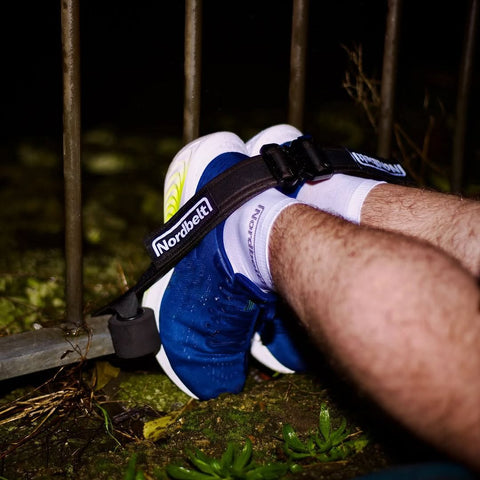
You do not need Nordbelt for a goblet squat. The Nordbelt homepage explains a different home setup: if you separately choose to practise Nordic curls, Nordbelt can secure your ankles to a suitable anchor point without a training partner or large gym machine. Check that your anchor point is suitable and follow the instructions for that separate exercise. This choice does not change your goblet squat weight or technique and is not an essential addition to your training.
Record what you actually did
Write down the equipment, weight, repetitions, chosen depth and reason for stopping. “Lighter went better” says less than “with the lighter kettlebell I kept the weight at my chest and my heels on the floor”. A short side-view recording can help a trainer discuss your execution; your own video is not a medical assessment.
A fictional example: Sam starts with a weight that pulls forward during the descent. Sam chooses a lighter one and keeps the same foot position. The next set is easier to repeat. The provisional decision is to use that lighter weight, rather than simultaneously squat deeper and add repetitions. This illustrates a decision process, not a tested protocol.

The photo illustrates recording a set; the notebook does not contain a prescribed training programme.
What does research say about this exercise?
An acute study compared goblet and landmine squats in 16 men and 16 women. They performed five repetitions with a load of 30% of their body mass; researchers measured muscle activity and ground reaction forces. This is not advice for beginners to start at 30%, and the study does not demonstrate long-term muscle growth or injury prevention (Collins et al., 2021).
Do not use a research load as your starting weight. The practical question remains whether you can repeat the movement with this equipment under control.
Frequently asked questions
Is a kettlebell or dumbbell better for the goblet squat?
Either can work if you can hold one weight securely at your chest. Shape and grip differ. Try light equipment and choose something you can safely pick up, hold and put down. A dumbbell that could come apart when held by one head is unsuitable. You do not need a particular brand for this choice.
How many kilos should a beginner start with?
There is no fixed starting weight for all beginners. Start without weight, then try a light load. Check grip, repeatable depth and controlled standing up. An online guideline cannot replace that trial set. If you cannot control the lightest available weight, first practise without weight or ask a trainer for a suitable next step.
Can my knees go past my toes?
That can happen during a squat. Knee position relative to your toes alone does not tell you whether the whole execution suits you. Also consider foot contact, trunk control and chosen depth. Do not force your knees backwards to meet a rule. If you have symptoms or individual treatment advice, have your execution assessed accordingly.
What if my arms tire before my legs?
Grip and holding position can limit the goblet squat. End the set before you can no longer hold the weight securely. Choose lighter equipment or discuss another squat variation if your goal requires more leg loading. Going heavier while your grip is already failing does not solve the problem; record this reason for stopping too.