

Posterior chain exercises: 7 options for home


Posterior chain exercises train the back of your body through several movements: extending the hip, flexing the knee, and keeping your trunk and pelvis stable. Think hip hinges, bridges, step-ups, bird dogs, slider curls, and Nordic curls. You do not need to perform all of them in one session. At home, choose one hip-dominant exercise, one knee-flexion exercise, and, if useful, one stability exercise.
The short answer: start with control and a range of motion you can repeat. Add weight, a longer lowering phase, or a harder lever only when your position remains stable. This lets you train the hamstrings, glutes, and back extensors as a coordinated system without pretending that one exercise covers the entire posterior chain.
What exactly are posterior chain exercises?
Posterior chain is a practical training term for the muscles along the back of the body. The hamstrings flex the knee and assist with hip extension. The glutes produce much of the force around the hip. The back extensors and other trunk muscles help maintain position, while the calves contribute during standing, walking, and pushing off. That does not mean you should program all of them as if they were one muscle.
A Romanian deadlift and a slider curl both work the back of the body, but they solve different training needs. The first is primarily a hip hinge; the second requires knee flexion while you control the hips. Research on different hamstring exercises also shows that activation patterns vary by movement (McAllister et al., 2014). Combine functions rather than merely collecting exercises that “burn in the hamstrings.”

How do you choose exercises to train the posterior chain?
Use three categories. First, choose a hip-extension exercise such as a hip hinge, Romanian deadlift, or step-up. Then choose an exercise with more knee flexion, such as a heel-drive bridge, slider curl, or Nordic progression. Add a stability exercise if you still find it difficult to keep your pelvis and trunk steady.
Ask four questions about every exercise:
- can you find the start and end positions without rushing;
- does the movement stay the same from the first repetition to the last;
- can you increase the load in a small, measurable step;
- does the exercise suit your available floor space, equipment, and recovery?
The general guide to hamstring exercises helps when knee flexion is your main focus. The selection below remains broader and centers on how the hip, knee, and trunk work together.
Explore this topic further: Reverse hyperextension for hamstrings: technique and setup.
1. Bodyweight hip hinge
Stand with your feet about hip-width apart, keep your knees slightly bent, and send your hips back. Your torso tips forward while your back position stays steady. Stop as soon as you can no longer move your hips back without changing your posture. Push the floor away and return through the hips.
This version teaches the movement pattern before you add weight. A dowel touching your head, upper back, and sacrum can provide feedback. If you lose one point of contact, shorten the range. For a complete technical progression, use the separate guide on learning the hip hinge.
Take your Nordic curl from the first rep to week 10.
A concrete 7-page plan: build up week by week, without pushing too fast.
- 01A clear week-by-week progression
- 02Technique and the mistakes to avoid
- 03A simple log you will actually use

≤51%
✓Backed by research
Van Dyk et al., 2019: meta-analysis of programmes with NHE. Not an effect test of Nordbelt or this protocol.
Open the download page again or check the email we sent you.
Open the download page ↗2. Heel-drive glute bridge
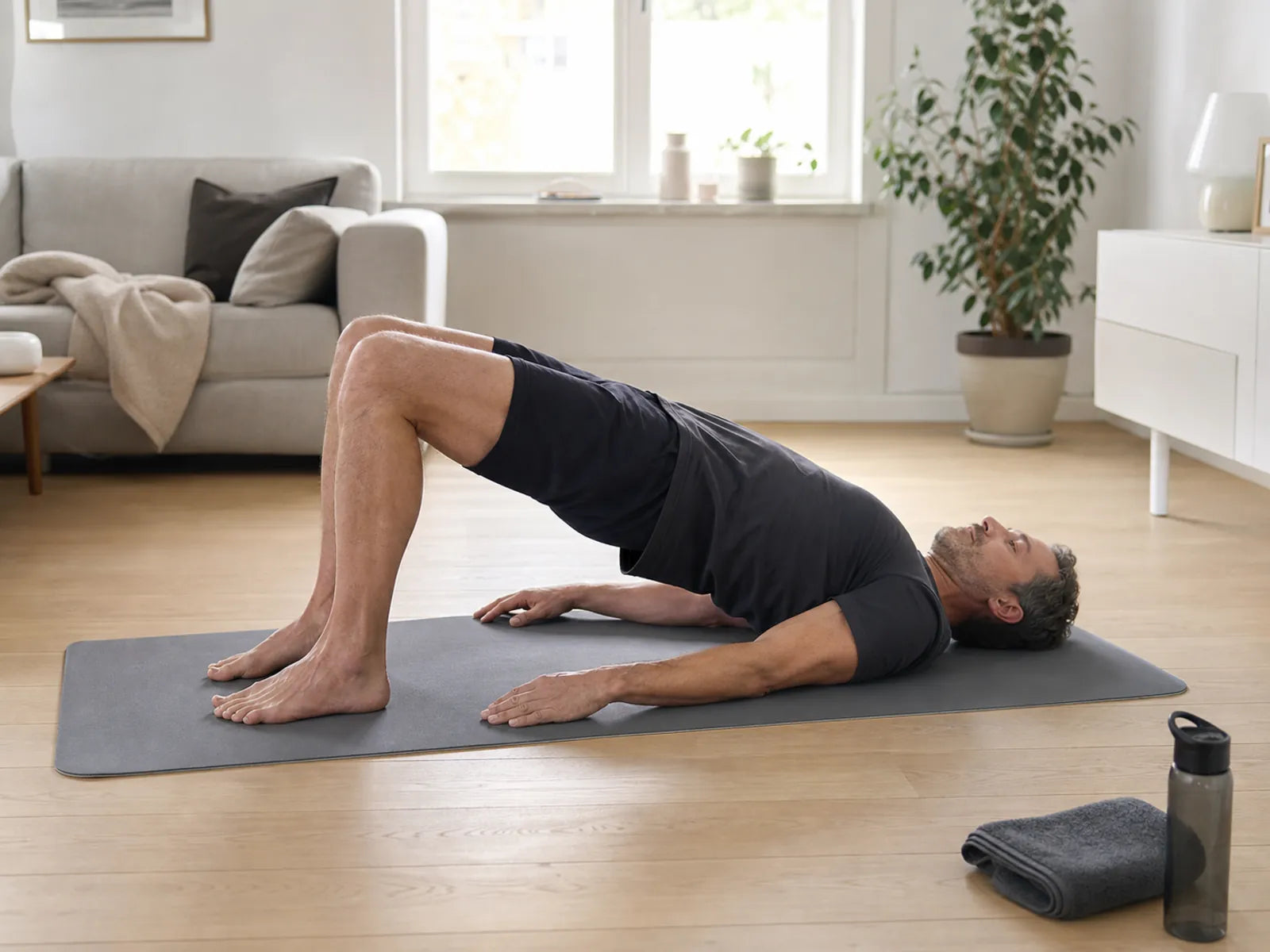
Lie on your back, plant your feet firmly, and raise your hips in a controlled motion. Pause briefly at the top without lifting your ribs. Gently pulling your heels toward you without moving them encourages the hamstrings and glutes to work together.
Start with two sets of eight controlled repetitions. First make the exercise harder with a longer pause or a little more distance between your hips and heels. A single-leg version comes later. To explore glute function further, read the guide to training your glutes at home.
3. Romanian deadlift with a backpack or dumbbells
Perform the same hip hinge, but hold an evenly loaded backpack close to your body or use two dumbbells. Lower the load along your legs and stop where you can maintain your position and tension. Depth is not a goal in itself.
A light load with a three-second lowering phase often provides more useful information than immediately adding weight. Progressive resistance training means planning changes in volume, resistance, exercise selection, and rest—not making every session heavier (Ratamess et al., 2009). Increase one variable at a time.
4. Step-up with a controlled descent
Place one whole foot on a stable, low step. Push through that foot, stand tall, and then lower yourself slowly. Keep your knee, foot, and hip in an alignment you can control. Use a wall or handrail for balance if needed.
A lower step does not make the movement less valuable; it makes controlled hip extension easier to measure. If you mainly feel yourself pushing off with the back leg, lower the step and slow down. It is also a practical single-leg option when you do not have heavy weights at home.
Ankle fixation for Nordic curls at home
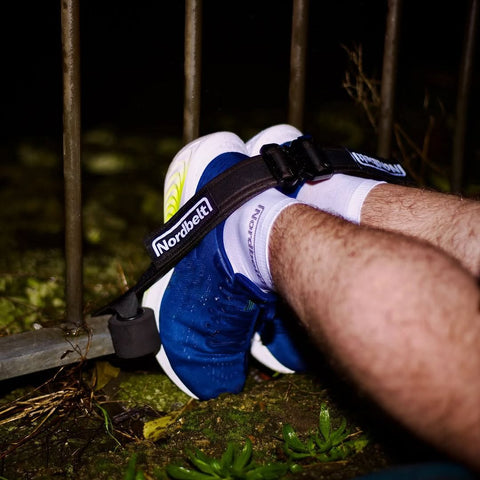
That is when a specific setup becomes relevant. With Nordbelt for stable ankle fixation during Nordic curls at home, you can secure both ankles to a suitable anchor point without a training partner or large fitness machine. It removes the fixation barrier for the Nordic stage once you have mastered simpler hinges, bridges, or sliders.
The setup does not replace checking the anchor point, using comfortable knee padding, keeping the movement path clear, or choosing an appropriate regression. Nor does it make the other posterior chain exercises unnecessary. Nordic curls place a high demand on controlled knee extension and the lowering phase; research shows that they can emphasize the hamstrings differently from hip-extension exercises (Bourne et al., 2017). Treat them as one targeted step within a broader plan.
5. Bird dog for trunk and pelvic control
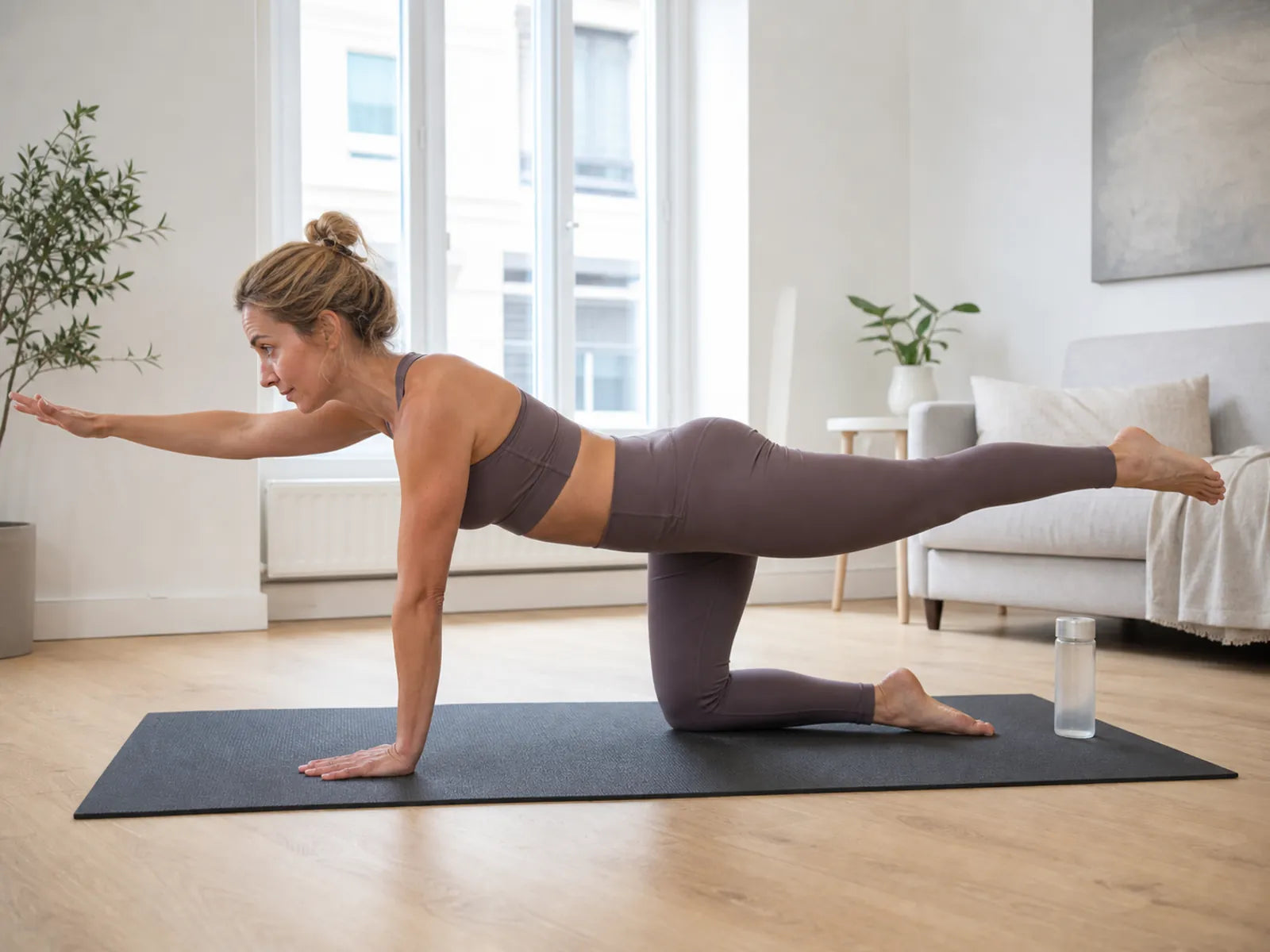
Start on your hands and knees. Extend one leg behind you and the opposite arm forward without rotating your hip open. Reach long, pause briefly, and return in a controlled motion. The movement does not need to be high.
The bird dog is not a heavy hamstring exercise. Its main purpose is to help you recognize whether you can extend the hip while keeping your trunk and pelvis steady. This makes it useful as preparation or between exercise sets, not as a replacement for strength training.
6. Slider curl for knee flexion
Lie in a bridge position with your heels on sliders, a towel, or socks on a suitable smooth floor. Slowly slide both feet away and pull them back while keeping your hips as stable as possible. Shorten the range if your hips drop.
Progress from short two-leg repetitions to a longer return, a slower lowering phase, or, much later, a single-leg version. The separate guide to hamstring slider exercises explains these regressions in more detail. Always check that the surface slides predictably and is free of obstacles.
7. Assisted Nordic curl
Kneel on a comfortable surface with both ankles secured low and symmetrically. Keep your hips and torso as close to one line as possible and lean forward through a small angle. Catch yourself with your hands and use assistance to return. Start with few repetitions and a short range of motion.
Reviews of Nordic programs describe changes in eccentric strength and muscle architecture, but the volumes and progressions used vary (Medeiros et al., 2020). That is a good reason not to treat the exercise as a daily test. The practical how-to guide shows the setup and basic execution; it does not replace an assessment of your anchor point or training level.
How to train the posterior chain at home
For two short sessions per week, this schedule is easy to follow:
Session A
- Hip hinge: 2 sets of 6 controlled repetitions.
- Glute bridge: 2 to 3 sets of 8 to 12 repetitions.
- Step-up: 2 sets of 6 to 10 per side.
- Bird dog: 2 sets of 5 controlled repetitions per side.
Session B
- Romanian deadlift: 3 sets of 6 to 10 repetitions.
- Slider curl: 2 to 3 sets of 5 to 10 repetitions.
- Assisted Nordic curl: only when appropriate, 2 short sets with plenty left in reserve.
This is a selection model, not an individual prescription. Leave at least one repeatable step between levels: technique first, then range of motion, then tempo or repetitions, and only then extra resistance. If you experience sharp pain, sudden loss of strength, or symptoms that keep returning, stop forcing the movement and have the situation assessed by a qualified healthcare professional.
Common mistakes in strength training for the back of the body
The first mistake is doing only heavy hinges. That leaves out controlled knee flexion and stabilization. The second is taking every exercise to the point where fatigue makes your technique untidy. The third is adding more weight, more repetitions, and more range of motion all at once.
A useful posterior chain program is easy to track. Record the exercise, sets, repetitions, tempo, and how you feel the next day. If your execution stays consistent, choose one small progression. If your back position becomes unstable, your hips drop during curls, or you lose balance during step-ups, move back one step.
Frequently asked questions about posterior chain exercises
Which muscles do posterior chain exercises train?
They mainly train muscles that work together in hip extension, knee flexion, and trunk stabilization, including the glutes, hamstrings, back extensors, and, in some movements, the calves. The emphasis varies by exercise. A hip hinge is hip-dominant, a slider curl demands more knee flexion, and a bird dog focuses mainly on control.
What are good posterior chain exercises for home?
A practical combination is a hip hinge or Romanian deadlift, glute bridge, step-up, slider curl, and bird dog. Assisted Nordic curls are a later option when you have basic control, suitable ankle fixation, and a safe, clear movement area. Choose two to four exercises per session instead of doing everything at once.
Can you train the hamstrings, glutes, and lower back together?
Yes, these areas work together in many hip-dominant exercises. That does not mean every muscle receives the same load. Combine a hip hinge for hip extension with a curl for knee flexion and a controlled stability exercise. This distributes the training functions more effectively.
Which hip-extension exercises are suitable for beginners?
Start with a bodyweight hip hinge, glute bridge, and low step-up. These versions make position and tempo easy to see. Once you can repeat the same movement pattern across several sessions, add a backpack, dumbbells, a longer pause, or a slower descent.
How often can you train the posterior chain?
Two sessions per week is a manageable starting point for many people who train at home, but recovery depends on the exercise, volume, experience, and other activities. Heavy Romanian deadlifts, sliders, and Nordics generally require more recovery than a bird dog or light hinge. Increase the workload only when your technique and response between sessions remain stable.