★ 4.6
Leg curl: toes in or out for your hamstrings?

Foot rotation can change measured hamstring activity. That does not prove isolation or extra growth. Choose a repeatable position without forcing rotation.
FREE 10-WEEK TRAINING PROTOCOLSend my free protocol ↓Turning your toes in or out during a leg curl can change measured muscle activity. That does not prove that you completely isolate a hamstring or achieve more muscle growth. Start with a comfortable, repeatable foot position that suits the machine. Do not force your feet against the roller or a fixed attachment. A muscle-activity finding is not compulsory technique advice. The two measurement studies are discussed separately below (Beuchat et al., 2019; Beyer et al., 2019).
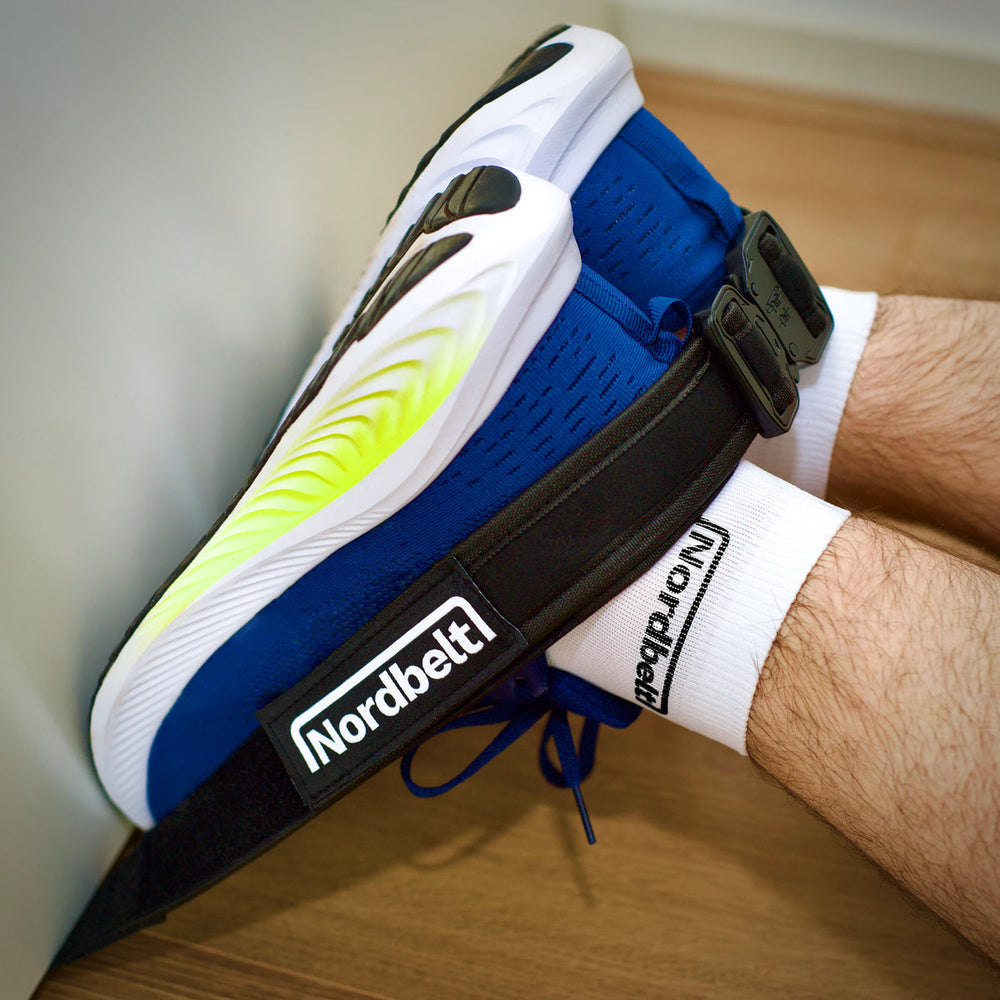
If you also want to do Nordic curls independently at home, see how Nordbelt secures your ankles without a training partner. You need a suitable, stable anchor and space to catch yourself. The tool does not turn a leg curl into an isolation exercise or determine an optimal foot position. Choosing Nordic curls is a separate decision from whether to rotate your toes during a machine curl.
What does turning your toes in or out mean?
Here, we mean the direction in which the foot and lower leg rotate. This differs from pulling your toes up or pointing your foot through the ankle. Curling your toes is another movement again. A photograph of a shoe therefore does not automatically tell you which position a study used.
Do not make a visible toe direction a goal in itself. If you rotate your whole leg or pelvis to point your shoe differently, you change more than the intended foot position. Start with the machine and movement you actually want to use. The separate guide to adjusting a leg curl machine for your hamstrings covers the knee axis, supports and roller; those settings are not repeated here.

What did the two studies measure?
Beuchat and Maffiuletti studied twenty people nine to fifteen months after anterior cruciate ligament reconstruction using a semitendinosus-gracilis tendon graft. During prone leg curls, measured medial hamstring activity was higher with inward and lower with outward foot rotation than in neutral. The difference was not significant for the bridge or Nordic curl. These were acute EMG measurements, not muscle growth after a training period (Beuchat et al., 2019).
Beyer and colleagues asked eighteen healthy young adults to perform maximal isometric knee flexion at different knee angles and lower-leg positions. They measured muscle activity and force; the results depended on the test position. An isometric laboratory task is not a moving machine curl. This study did not test a long-term training programme with toes turned in or out either (Beyer et al., 2019).
Why does greater activation not mean isolation?
EMG describes electrical muscle activity during the measured task. A difference in that signal does not show that other muscles stop contributing. Both studies above measure an immediate response to a test position; neither compares muscle growth after weeks of training. You therefore cannot infer a growth guarantee for a particular foot position (Beuchat et al., 2019; Beyer et al., 2019).
Suppose you feel a variation more strongly on the inner side. You can record that experience, but do not automatically write that you isolated that muscle. The same applies to a burning sensation or a higher number on the weight stack. Keep three questions separate: what was measured, what can you perform comfortably, and which longer-term outcome was actually studied?
Take your Nordic curl from the first rep to week 10.
A concrete 7-page plan: build up week by week, without pushing too fast.
PDF7 pagesStraight to your inbox
- 01A clear week-by-week progression
- 02Technique and the mistakes to avoid
- 03A simple log you will actually use

Open the download page again or check the email we sent you.
Open the download page ↗≤ 51%
✓Backed by research
Van Dyk et al., 2019: meta-analysis of programmes with NHE. Not an effect test of Nordbelt or this protocol.
A decision card for your next session
Use this card as a practical aid, not a tested protocol or medical test. It deliberately gives no compulsory rotation angle.
| Your situation | A useful next step | Which conclusion should you avoid? |
|---|---|---|
| You are starting a leg curl | Choose a comfortable, repeatable position according to the machine instructions. | That a conspicuous toe angle is essential. |
| Another position requires pushing or twisting | Stop and restore a suitable starting position first. | That more rotation produces better results. |
| A variation feels different | Describe the experience and keep other settings unchanged. | That a sensation proves isolation or growth. |
| You follow a supervised programme | Discuss a change with the person supervising you. | That a general research abstract replaces your prescription. |
Choosing between seated and lying curls is a different decision. Hip position changes too. Use the comparison of seated and lying leg curls for that question, without transferring those exercise-choice findings to foot rotation.
Make your execution recognisable
After your set, briefly note the machine, your comfortable foot position and whether execution remained repeatable. For example: same machine and settings, feet without forced rotation, roller stayed in place. Add an observation in ordinary language. A short note is enough; you do not need to calculate an angle from a phone photograph.
Do not change the machine, resistance, range of motion and foot position together when you only want to assess one practical adjustment. Otherwise, you cannot tell what a different experience relates to. These notes do not turn training into a force or activation measurement. They simply help you reproduce the same task. A painful position is not a useful comparison: stop that movement.
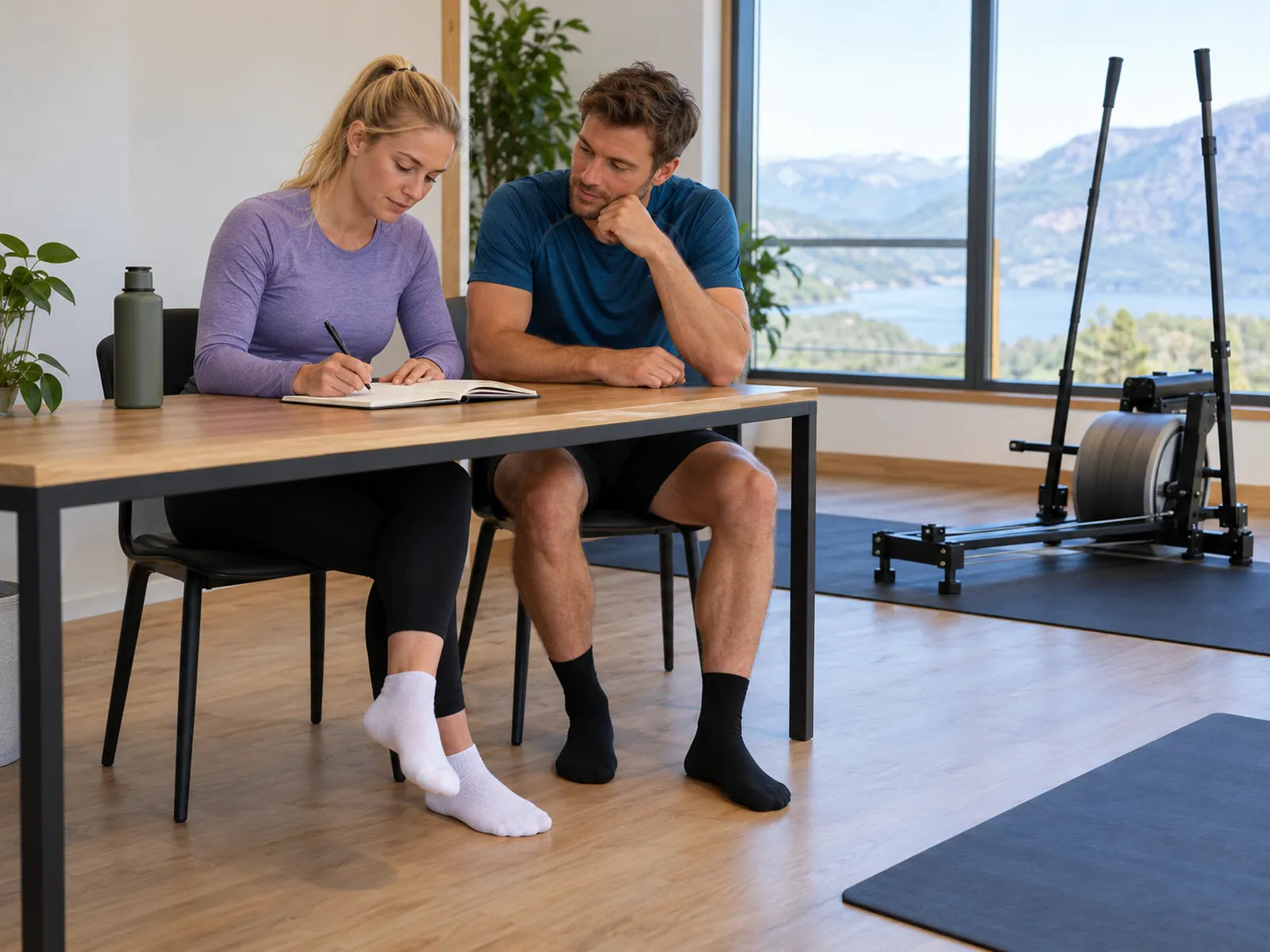
Context image for recording your execution; the notebook shows no readable training programme or research data.
Why should you not twist fixed Nordic ankles?
During a Nordic curl, your ankles remain secured while your body moves forwards from kneeling. This differs from moving your lower legs against a machine roller. Do not imitate a research position by twisting against a loaded ankle strap. Pulling your toes up or pointing your feet is explained separately in ankle position during Nordic curls.
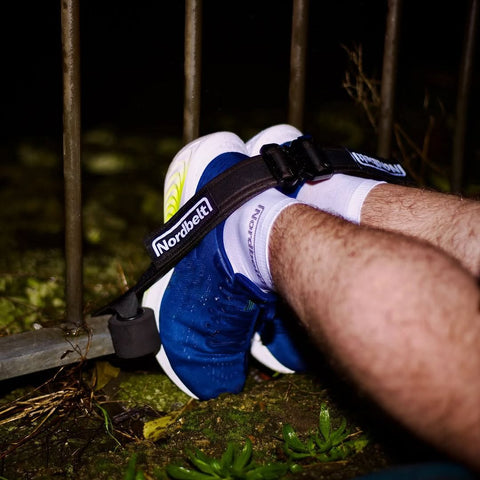
If you choose that exercise later, provide knee padding, a non-slip surface and clear space for your hands. Use only a suitable, sturdy, fully closed door from the intended side, or a bench or fence that cannot shift or tip. Test the attachment under light tension first. Start upright, keep the line from knees to shoulders as consistent as possible and lower forwards a short distance under control. Catch yourself with your hands in time and use them to return. An attachment does not catch your upper body.
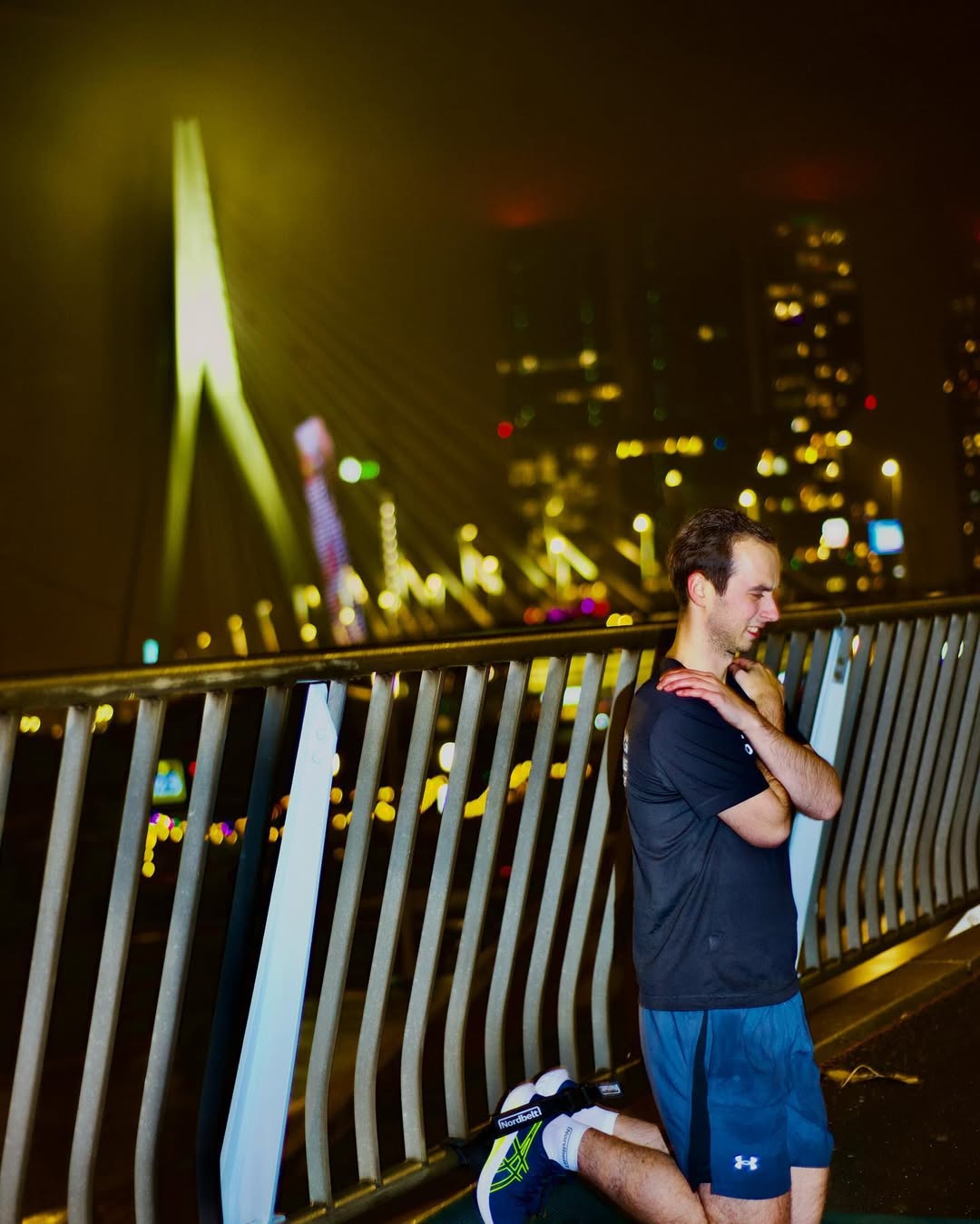
This is a Nordic starting position, not a demonstration of foot rotation or the complete lowering movement.
Frequently asked questions
Do toes-in curls train only the medial hamstrings?
No. A difference in measured activity does not mean complete isolation. The postoperative study found a change during prone curls; it did not test whether one muscle grew separately because of that position (Beuchat et al., 2019).
Must I always keep my feet perfectly straight?
These two measurement studies do not establish one universally compulsory position. Choose a comfortable position you can repeat without twisting and that fits the machine instructions. Do not force an end position in pursuit of a supposedly optimal effect.
Can I use the same foot rotation during Nordic curls?
Do not treat machine curls as instructions for fixed ankles. Adjust an attachment only while unloaded and according to its instructions. Stop if your foot turns inside the strap, the support shifts or you feel pressure, pain or tingling.
Is the study after cruciate ligament surgery also rehabilitation advice?
No. Those participants had a specific operation and measurement context. An abstract does not determine what your knee can currently tolerate. Discuss exercise choice and foot position with your clinician. Have persistent, worsening or unexplained symptoms assessed and do not train through sharp pain.