

HYROX doubles: running together, sharing work and agreeing a plan

In HYROX doubles, you race with a partner and share the work at the stations within the current rules. You do not automatically halve the running. Choose doubles if you want to race together and agree on running pace, changes and workload. Different strength or running abilities call for concrete decisions beforehand; they do not, by themselves, make you an unsuitable pair.
What changes compared with singles?
The HYROX Doubles rulebook for the 26/27 season requires both participants to complete every running section together. You also enter and leave a station together; work begins only when both are present. In singles, you perform the race tasks yourself. Doubles allows you to share station work, but it is not a relay in which your partner takes over your run.
If the events are unfamiliar, start with the HYROX beginner’s guide. Here the additional decision is whether you want to make decisions and adjustments together or each manage your own race.

Talk about your shared running pace
Do not compare personal bests alone. Discuss how you run together after doing an exercise you already know. Agree on a simple signal for slowing down, such as “easier”, and have the other person acknowledge it. Running ahead to wait at the next station does not fit racing together.
A training watch can support the conversation, but it cannot prescribe your pace as a pair. If you use different zone labels, first read the explanation of zone 2 and training-zone models. Agree on what you observe and how you respond, instead of treating two potentially different watch scales as equivalent.

General running context: this solo runner is not demonstrating a HYROX doubles race or a prescribed pace for a pair.
Fill in a discussion card before practising
Use this card for each station you already know. It is an editorial discussion aid, not a tested racing strategy. Add the current station rules as constraints: loads, movement standards and permitted changes vary by event and division.
| Decision | What exactly will you agree? | What will you observe in practice? |
|---|---|---|
| Starting | Who starts, and how do you confirm it? | Do you both understand the task before anyone begins? |
| Changing over | Which signal announces the handover? | Does your partner hear it, and is the permitted change clear? |
| Sharing work | What provisional share suits controlled execution? | Does the movement remain controlled, and can you explain the agreement? |
| Moving on | How will you check that the station is finished? | Is the work complete, and are both ready to leave together? |
There is no general requirement for each person to do exactly half. The current rules, for example, allow self-selected changeovers in rowing. That does not make every imaginable change at other stations permissible. Under the doubles rules, the resting participant stays on their feet within the designated area without obstructing others.
Take your Nordic curl from the first rep to week 10.
A concrete 7-page plan: build up week by week, without pushing too fast.
- 01A clear week-by-week progression
- 02Technique and the mistakes to avoid
- 03A simple log you will actually use

≤51%
✓Backed by research
Van Dyk et al., 2019: meta-analysis of programmes with NHE. Not an effect test of Nordbelt or this protocol.
Open the download page again or check the email we sent you.
Open the download page ↗What if your abilities differ?
Fictional pair: Noor and Sam. Noor finds running easier; Sam is more proficient at a particular station. They first agree on a shared running pace, then practise a workload split that matches their controlled execution at that station. Noor does not run ahead to compensate for Sam’s station work. Afterwards, they discuss whether their signals were clear and how the next run began.
Fictional pair: Inez and Ravi. Their individual running abilities are similar, but Ravi loses track during a changeover. They simplify the agreement: a designated starter and one recognisable handover signal. They practise that action before making it a full race simulation. Their example promises no faster finish; it identifies the problem their next practice needs to address.
A study of eleven recreational participants with previous HYROX experience measured acute exertion and performance associations during a simulated individual race. It did not study pairs or establish an optimal workload split (Brandt et al., 2025). Do not use that study to sell a fixed allocation or guaranteed time saving.
Would you also like to add Nordic curls at home?
Your teamwork agreements need no training product. If you separately choose to add Nordic curls at home, Nordbelt makes that home setup practical with stable ankle fixation, without a training partner or large machine. You still need a suitable anchor, knee support and room to catch yourself with your hands. This is a separate exercise choice, not a station-change aid or proof that you are race-ready. Read the Nordic hamstring curl guide for that exercise.
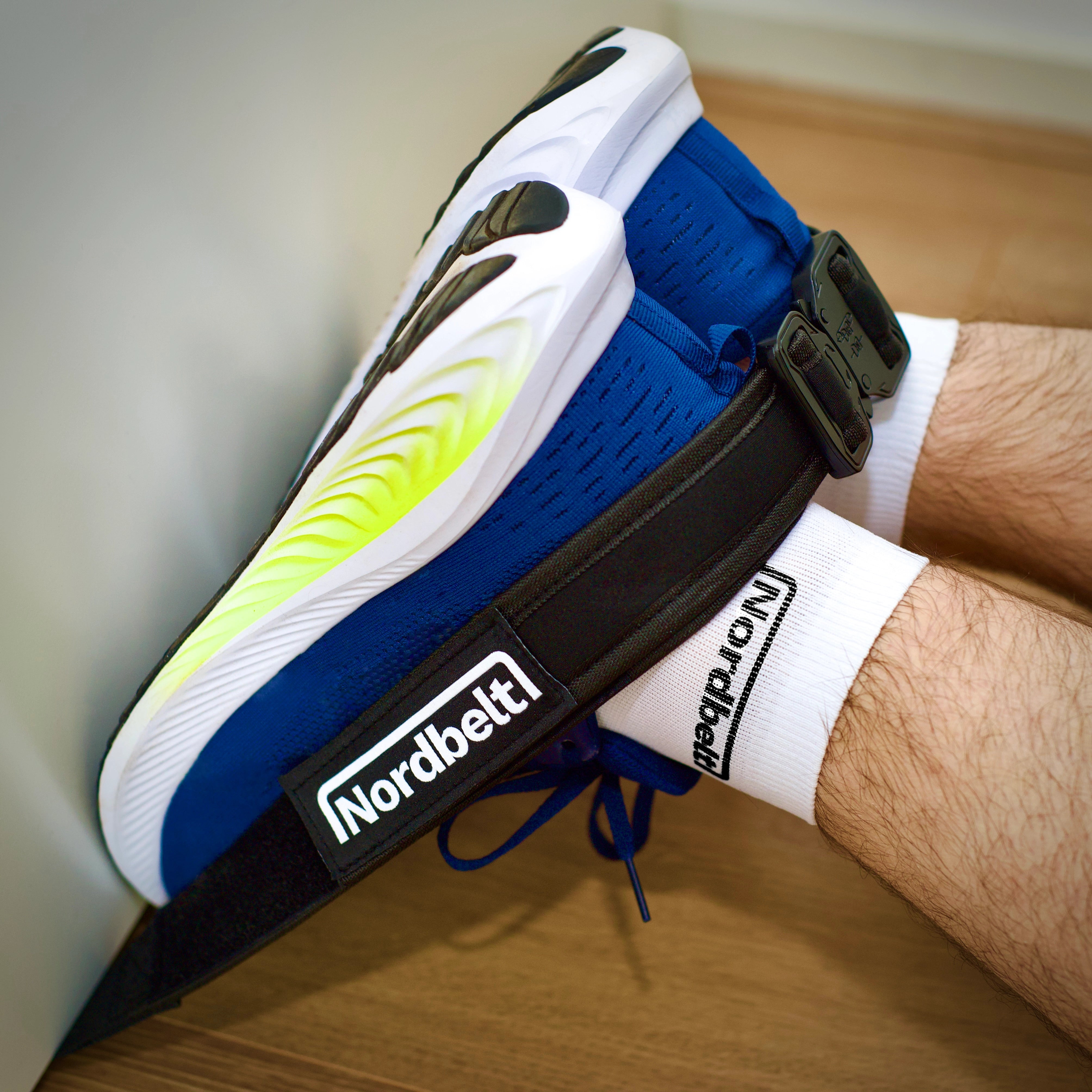
Ankle straps for a separate Nordic curl setup at home. The image shows the fit, not a HYROX station or the complete exercise.
Frequently asked questions
Must you split everything equally in HYROX doubles?
No. Working as equal partners does not mean doing an identical share at every station. Follow the permitted workload and changeover rules for that station. Then record a provisional agreement you both understand and can execute. Do not silently change the task when someone gets tired: use your agreed signal and acknowledge the handover. A written split is a starting point for practice, not an individual performance guarantee.
Is doubles easier than singles?
You can share station work, but you still run together and coordinate execution and changes. “Easier” means little without your experience and goals. Do not choose doubles solely because you expect to do half the effort. Discuss whether you want to race together, want the same kind of experience and can make time to practise agreements. Singles may suit you better if you mainly want to manage your own execution.
Can a fast runner partner with a stronger lifter?
That may be a reason to explore doubles, but those labels do not prove a good match. A strong athlete must also manage the running, while a good runner needs to understand station rules and movements. Discuss specific tasks and try your agreements under control. If you cannot control a movement, seek coaching before adding work or speed. Persistent symptoms need assessment, not a partner expected to compensate for them.
Must we do every training session together now?
Not every session has to become a joint project. Identify which agreement actually needs joint practice and which general preparation you each already do. A review of 43 studies in healthy adults found no significant average difference in maximal strength or muscle growth between combined endurance and strength training and the same strength training alone. Explosive strength gains could be smaller, particularly within the same session. This does not establish an optimal doubles training week (Schumann et al., 2022).
What should we record after practising together?
Write down the station, load, agreed changeover and what actually happened. For example: “Sam missed the handover signal; next time he acknowledges it before Noor stops.” That is more useful than “poor teamwork”. Record whether the next shared run still matched your agreement. Change one specific communication point next time. Read the note together: does it describe an observable action or merely judge your partner? Do not treat it as a validated readiness test or a reason to ignore pain or loss of control.